
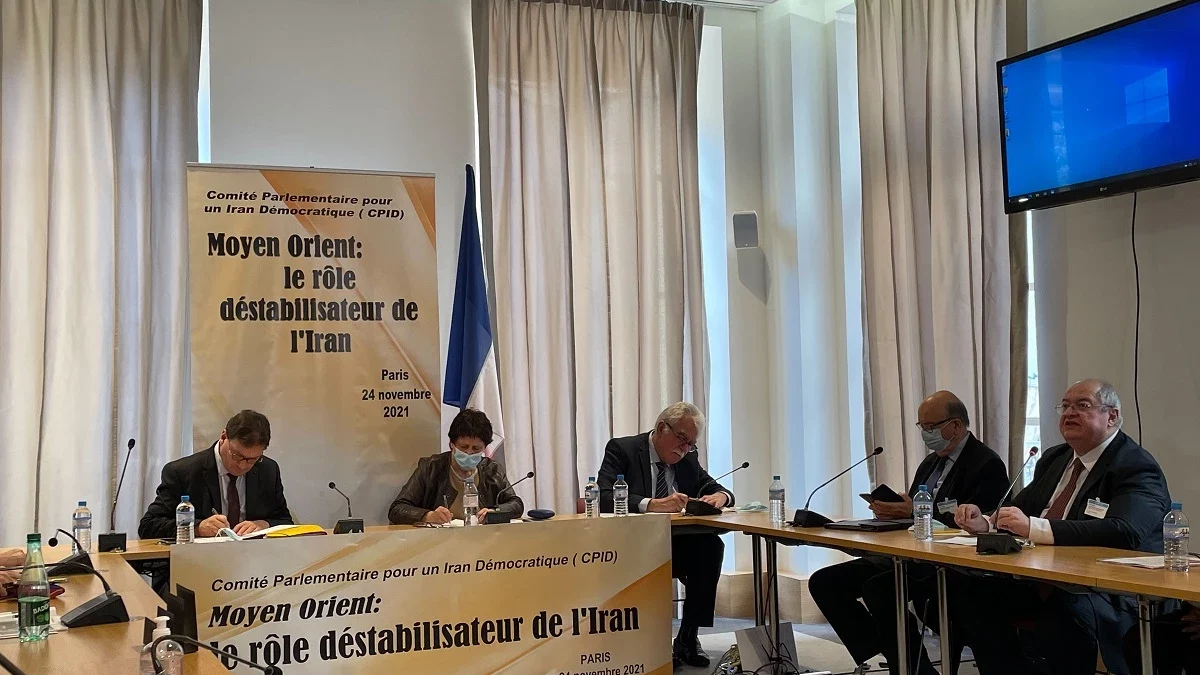
National Assembly, 24 November 2021
FEMO’s Secretary General, Nader Nouri, spoke at a conference at the National Assembly on 24 November, held at the initiative of the Parliamentary Committee for a Democratic Iran (CPID). French MPs who are members of the CPID took part in this conference, entitled: “The Middle East: Iran’s Destabilising Role.”
Below is the text of Mr Nader Nouri’s address.
Introduction
Allow me first to recall a key point for understanding the heart of what has been called, for four decades now, “the Iranian question” or “the Iranian crisis”: it lies in the fundamental opposition between a population effectively held hostage and rulers who have lost all legitimacy — hence the genesis of a military nuclear programme aimed at acquiring the atomic bomb to entrench the regime, the major international crisis that followed, as well as a vast offensive ballistic missile programme and an expansionist policy targeting most countries of the Near and Middle East and the Persian Gulf. All of this is part of a survival strategy in the face of a population in revolt, as demonstrated by the ferocious repression of November 2019.
We will see that on all these fronts, the policy pursued by the Islamic Republic runs counter to French policy, which seeks, first, to contain nuclear proliferation (France has always played a leading role in this field) and, second, to contribute to peace, stability and economic prosperity in the countries of the region, particularly historic allies such as Lebanon and Iraq.
On the nuclear issue
— The Vienna talks, which began last April between Tehran and Washington via the European troika (along with Russia and China, despite their ambiguous role) to revive the 2015 nuclear deal, have been at a standstill for nearly five months, amid the total grip of Supreme Leader Khamenei’s faction over the executive, legislative and judicial powers. Meanwhile, the regime has accelerated its uranium enrichment programme to rates and volumes far exceeding those authorised under the 2015 agreement, and above all has ceased any meaningful cooperation with the IAEA.
— The statements by Mr Grossi, Director General of the IAEA, expressing his deep concern over the regime’s real nuclear activities, are highly revealing — notably his statement that only countries with military nuclear ambitions enrich uranium to levels as high as 60%… and the fact that he says he is at a loss as to being unable to speak with any political leader (Foreign Minister Amir-Abdollahian and President Raisi being “unreachable”), with Mohammad Eslami, head of the AEOI, his sole interlocutor!
— Everything indicates that the regime is accelerating its programme to reach a point of nuclear no-return, in order to present the international community with a fait accompli. Its behaviour clearly shows that it does not take Western and IAEA warnings seriously, since it faces a US administration eager to conclude a deal, even a provisional one… and a rather complacent EU…
Except for France, where there appears to be a growing awareness and willingness to confront the threat more firmly (statements by Le Drian in Le Monde, plus a Quai d’Orsay statement calling on the IAEA/Board of Governors to take a firmer stance toward the regime).
— Bagheri-Kani’s visit to Paris did not produce the outcome the regime had hoped for (rallying France and the Europeans to its positions by exploiting current disagreements with the US)…
— The only solution is for the IAEA to refer the matter to the UN Security Council and invoke Chapter 7 of the UN Charter (which the regime is desperate to avoid at all costs, hence its current delaying manoeuvres). France can play an important role in this process by taking the helm of the EU in January…
Regional expansionism
— Here too, the regime has sought to extend its “strategic depth” by influencing and instrumentalising Shia communities, owing to its distrust of the population inside the country.
— It tries to project its internal problems onto external crises in order to divert the outside world’s attention from the very serious situation at home.
— In doing so, it masks its internal weakness (the appointment of Raisi and the tightening grip on the Majlis are signs of weakness, not strength).
— Yet even in its zones of influence in the region, things are going badly for the regime:
Iraq: the October elections, which resulted in a resounding defeat for the political front of the pro-Tehran militias in the Iraqi parliament, show that wherever there is a minimum of rule of law and free, fair elections, the violent obscurantist forces beholden to the mullahs stand little chance of winning (recall the Iraqi uprising of October 2019, including in the Shia south, against the regime’s presence and the influence of its proxies/the Quds Force — the consulates burned down in Najaf and Basra).
These forces responded with brute force and attempted to assassinate PM Al-Kadhimi, an act strongly condemned by France among others (a phone conversation between Le Drian and Amir-Abdollahian).
In Lebanon
The 2019 popular uprising against the Hezbollah-controlled government, sparked by shortages and the economic collapse of the system; here too Hezbollah has resorted to brute force, assassinating opponents and even attempting to forcibly remove an investigating judge looking into Hezbollah’s role in the deadly, criminal Beirut port explosion…
— President Macron’s plans and initiatives in Lebanon were thwarted by Hezbollah, which carries out Tehran’s policies (see Alain Frachon’s article in Le Monde)…
— In Iraq, the conference on regional peace and stability organised in August under French chairmanship is doomed to fail as long as the Islamic Republic remains the dominant force in that country, one which it wants to keep weak, divided and unstable in order to continue using it as a battleground and a source of crisis…
Conclusion: the West, and the Europeans in particular, must decide once and for all to stand concretely and visibly alongside the Iranian people, in order to send a clear message to both the people and the rulers (as with Belarus, for example): this means no longer allowing themselves to be misled by the nuclear issue or intimidated by the regime’s aggressiveness and brutal practices such as hostage-taking or terrorism, and instead acting firmly on the question of human rights…