
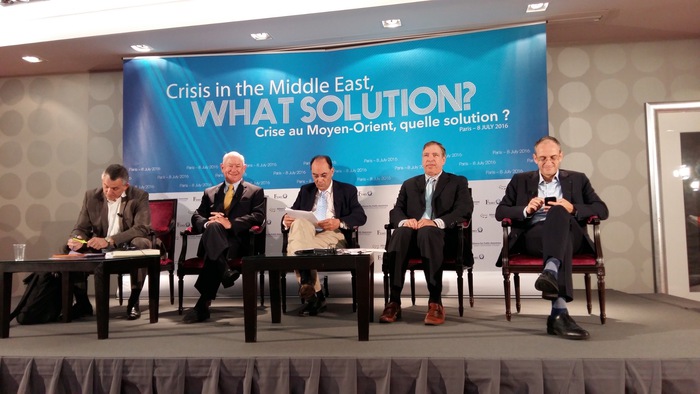
International conference in Paris
On Friday, 8 July 2016, a conference co-organised by FEMO and the Alliance for Public Awareness (APA-ICE) was held in Roissy-en-France on the theme: “Crisis in the Middle East: What Solutions?” The event brought together numerous French and international figures from the worlds of politics, academia and journalism to exchange views on the situation in the Middle East, the issues it raises, and what current policies are lacking to address it effectively. While there was broad consensus on the state of affairs, the discussions also gave each participant the opportunity to propose new avenues for reflection.
First round table: Crises in the Middle East, Outlook and Solutions
With Alejo Vidal-Quadras, Frédéric Encel, Philip Crowley, Marc Ginsberg, and Jean-Sylvestre Mongrenier.
The discussion first took stock of the general situation. The speakers then proposed ideas that Western foreign policy should draw on in order to act more effectively on the ground in the region. According to these experts, the region is currently undermined by the destabilisation strategy of the Shia Islamic regime. All of them called for the expansionist ambitions of the mullahs in the region not to be underestimated, placing them on the same level of danger as those of the Islamic State group, and urged the world to fight both enemies simultaneously. They highlighted the lack of a shared regional strategy and policy among American, European and Arab allies to confront these threats together. The absence of a strategy to contain Iran’s nuclear and hegemonic ambitions was also criticised. The world, they argued, lacks truly effective policies to address Middle Eastern crises in general, and to counter the rise of the ayatollahs’ regime in particular.
Discussing the situation in Syria, former American official Philip Crowley identified five distinct conflicts: Bashar al-Assad versus the Syrian opposition; Iran’s hegemonic ambitions versus those of the Gulf states; the Islamic State group versus Jabhat al-Nusra; Israel versus Hezbollah; and the United States versus Russia, still locked in what Crowley called a “competition.” He then raised the question of whether there might, in the end, be several Syrias, several Iraqs, and several Yemens. Crowley noted that, beyond the importance of fighting and destroying terrorist groups active in the Middle East, greater attention must also be paid to how the region will be structured and governed in the future.
Finally, former US Ambassador Marc Ginsberg pointed to the “collapse of the Arab world” — “if indeed there ever was one” — accelerated by the Arab Spring and by the growing political and military power of the region’s two other major powers, Iran and Israel.
Second round table: One Year After the Nuclear Agreement
With Lincoln Bloomfield, Mitchell Reiss, Bruno Tertrais, Robert Torricelli, Robert Joseph, and Frances Townsend.
The discussion then turned more specifically to Iran, one year after the signing of the Vienna agreement on 14 July 2015. The central question raised was Tehran’s compliance with the deal, but not the only one: Mitchell Reiss also raised the question of the P5+1 powers’ ability to reimpose sanctions in the event of a violation, noting that some administrations — the American one in particular — had failed to grasp the scale of the Iranian threat early enough in the negotiation process.
While the United States believed the agreement would change Iran’s attitude toward the West — notably regarding cooperation in Syria and the fight against ISIS — and, by extension, the dynamics of the Middle East, this bet has proven “lost,” according to specialist Bruno Tertrais, for whom the Islamic Republic’s responsibility for the regional chaos is undeniable. The Vienna agreement, he argued, has had “no impact” on Iranian support for terrorism in the region.
According to Lincoln Bloomfield, the regime has in fact become even more assertive, both domestically and internationally, with no discernible spirit of reform in Iran since the end of the negotiations. Ultimately, the agreement is said to have given the regime greater strength and capacity, both to repress its own population and to become more involved in regional conflicts. Moreover, Tehran is believed to still hold significant nuclear capabilities that the agreement failed to eliminate. Compliance with the deal is also said to be “unverifiable,” with some of its provisions allowing the regime to actively — and covertly — pursue its programme.
This is why the reality remains deeply “worrying” in the eyes of our speakers, all of whom stressed the idea of at least a partial failure of the P5+1’s negotiating policies. Some even called for a radical change of approach. The major powers that signed the agreement should, they argued, put greater pressure on Khamenei’s regime, without which it will never move in the right direction. However, with most of these countries approaching a presidential transition, it will be these “new administrations” that will soon have to face “old problems,” in ways that cannot be predicted. Regardless, constant vigilance and firmness toward Tehran are expected.
Third round table: Developments in Iran and the Role of the Opposition
With Lincoln Bloomfield, Kenneth Blackwell, Linda Chavez, Howard Dean and Struan Stevenson.
During this final round table, Linda Chavez deplored the fact that everyday issues facing ordinary people and the state of human rights in Iran were not part of the nuclear negotiations. According to the President of the Center for Equal Opportunity, Tehran got what it wanted without giving any assurance in return of a future opening of the country, whether in domestic or foreign policy. To this day, the human rights situation has not changed, and has even worsened in some respects. Iran, for instance, remains the country with the highest number of executions per capita in the world.
Kenneth Blackwell, former US Ambassador to the UN Human Rights Commission, put forward various ideas for addressing the Iranian problem, such as breaking with the status quo, or having the US administration make greater use of new technologies in implementing its foreign policy in order to better support the demands of the Iranian people.
Overall, all the speakers ultimately lamented the fact that the reality of what is happening in Iran is, most of the time, obscured. They therefore encouraged policymakers to bring it more into the open and to better support the Iranian opposition in its struggle for freedom and democracy, with some emphasising the central role of the NCRI (National Council of Resistance of Iran) coalition. Allowing the opposition to gain greater legitimacy in the world — particularly the Western world — by supporting it more actively could, in time, sufficiently weaken Khamenei’s regime, if not overthrow it, and replace it with a democracy.
See the event videos