
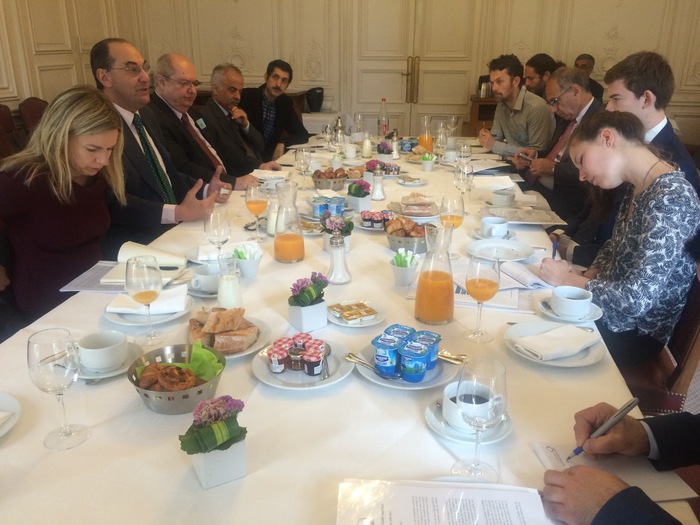
At FEMO’s initiative, a round table was held at the French Senate on Wednesday, 18 May 2016, on the theme “Iran: Structural and Financial Obstacles One Year After the Nuclear Agreement.” The round table, attended by journalists, business representatives and foreign embassy staff based in Paris, featured Alejo Vidal-Quadras, former Vice-President of the European Parliament and founder of the International Committee In Search of Justice (ISJ), and Mohammad Amin, analyst and research associate at FEMO, who presented their analyses of the internal situation in Iran nearly a year after the signing of the agreement on Tehran’s nuclear programme and five months after the lifting of international sanctions…
Alain Neri, Senator for Puy-de-Dôme (Auvergne-Rhône-Alpes) and Secretary of the Senate’s Committee on Foreign Affairs, Defence and the Armed Forces, opened the round table by welcoming participants and stressing the importance of a conference such as this and of exchanging views on the situation in the Middle East in general and in Iran in particular.
Address by Alejo Vidal-Quadras, President of the International Committee In Search of Justice, on “The Situation in Iran One Year After the Nuclear Agreement”
“I am pleased to take part in this FEMO conference held at the Senate. The Middle East is currently going through a phase of major turmoil that concerns the international community. At the heart of every crisis — in Iraq, Syria, Yemen and Lebanon — we invariably find the Iranian regime. Two questions arise in this context: is Iran heading toward a democratic opening and a rapprochement with the Western world? Can we finally see Iran taking the path of change from within?
For many years now, there has been hope and expectation in the West of seeing a positive evolution in the Iranian regime. But each time, the West has been disappointed. Rafsanjani was called the “pragmatist” and presented as someone who wanted to end Iran’s isolation — that was between 1989 and 1997. Then it was Khatami’s turn to be called “moderate,” expected to bring the anticipated changes in Tehran’s behaviour. Since 2013, with Rouhani coming to power, the same hopes were raised, this time culminating after the nuclear agreement. Every indication coming out of Iran suggests that those who set their expectations too high will once again be disappointed. In reality, very little — if anything — has changed in substance in Iran.
There is no sign of any political opening in the country. Some argue that the repressive apparatus is controlled by extremists and that Rouhani has no control over them. Even assuming this argument is correct, it is itself clear evidence that it makes no difference whether Rouhani is a moderate or not. The simple truth is that Rouhani has been part of the regime for far too long to act any differently. He belongs to the system.
One of the fundamental problems that Western media and political circles fail to pay sufficient attention to is the structure and composition of the regime. This regime is founded on the absolute primacy of the clergy. This is essential to understanding how things work in Iran. Article 110 of the Constitution enshrines the power of the Supreme Leader. He is, de facto, God’s representative on Earth. The three branches — legislative, executive and judicial — are all under his control. His decrees stand above the law. Indeed, the entire establishment of the system is heavily dependent on the will of the Supreme Leader. Any weakening of the Supreme Leader’s power would bring down the entire regime. That is his dilemma. Khatami, Rouhani and Rafsanjani all know that their own survival depends on preserving the “Islamic Republic,” and it is precisely for this reason that they need the Supreme Leader. Consequently, any effort to change the nature of the regime is doomed to fail.
A good example is the recent elections. In Iran, the electoral process is not truly a free exercise of popular sovereignty. As discussed in detail in the ISJ report published after the first round of elections, what takes place in Iran under the guise of voting more closely resembles a dispute between the regime’s various factions. There is no opposition in the Iranian parliament. Moreover, all candidates are vetted by individuals appointed by the Supreme Leader, and must prove their allegiance both in heart and in deeds. Consequently, the outcome of these elections is really determined more by the internal balance of power within the system than by the will of the people. The rejection of the pro-Khamenei faction did not ultimately benefit the other faction, but was rather a sign of growing discontent among an exasperated population. Even so, the result makes little difference: parliament holds no real power over major political matters.
Another important indicator is Iran’s policy in the region. Since Rouhani took office and since the nuclear agreement was signed a year ago, the Iranian regime has not changed its foreign policy. Despite heavy losses, with serious domestic repercussions, the regime has steadily increased its presence in Syria — deploying, in addition to the Revolutionary Guards and other militias, the regular army outside the country’s borders for the first time.
Any genuine change in behaviour and any real reform would require less intervention in Syria and greater cooperation to end the carnage there. Now that the United States and Europe are prepared to normalise trade with Iran and engage it as a regional player, a logical corollary would be for Iran to become more cooperative on the ground.
Zarif, the Foreign Minister, for instance, is supposed to be the epitome of moderation, yet on regional policy he is entirely aligned with Khamenei. In a letter of condolence to Hassan Nasrallah on the death of Mustafa Badreddine, Hezbollah’s military chief (the Lebanese branch of the Iranian Revolutionary Guards), who was killed in Syria the week before, Zarif praised him as “a great man” “full of passion for defending the just ideals of Islam.” In July 2015, during meetings with the Syrian dictator in Damascus and with Hassan Nasrallah in Beirut, Zarif congratulated them on their “fight against terrorism” and helped coordinate efforts to better crush the Syrian people’s revolution. In January 2014, he paid tribute to Imad Mughniyeh, Mustafa Badreddine’s predecessor, and laid a wreath on his grave.
Just last week, Rouhani himself praised the Revolutionary Guards, who he said were active “everywhere — in Afghanistan, Iraq, Syria, Lebanon and Palestine” — paying pointed tribute to “the courage and heroism of Commander Soleimani,” the man chiefly responsible for Iranian interference across the region.
What Western governments fail to understand is that these policies are part of the regime’s survival strategy. The mistaken perception in the West is that these actions are seen as a sign of strength. In reality, its aggressive approach in the region reveals its internal weakness. Syria is currently turning into a quagmire for the regime, yet at the same time it is unable to abandon it. One might well ask why, given the regime’s economic crisis, it continues to spend enormous sums of money on this war while the Iranian people live in poverty.
Of course, there are differences between the Khamenei camp and the Rafsanjani–Rouhani camp; of course, there is a power struggle; and it is true that internal confrontations within the regime are becoming increasingly fierce. But the disagreement is not between two factions with two opposing visions. As we have seen over all these years, both sides are entirely united on the regime’s fundamental principles: repression at home and the export of terrorism and fundamentalism to other Muslim countries. The increasingly visible struggle between the two camps is nothing more than the glaring illustration of the failure of a fragile system that has been unable to provide solutions to the problems of the Iranian people.”
Address by Mohammad Amin
Iran: Financial and Political Instability, by Mohammad Amin
“In recent analyses and studies on the difficulties surrounding economic relations with Iran, external factors have often been given priority.
In this presentation, I will try to focus on the internal factors that have a much greater impact on Iran’s economy and politics, in order to obtain a more realistic picture of the situation.
Today, the initially optimistic forecasts of an Iranian El Dorado have faded. European banks are refusing to finance projects and transactions with Iran, partly because the United States has maintained a range of sanctions decided before the 14 July 2015 nuclear agreement, on top of the continued ban on dollar-denominated transactions with the country. In this context, banks risk being sanctioned again by Washington, as happened with the French bank BNP Paribas or the British bank HSBC, which had to pay colossal fines — 8.9 billion dollars for the former and 1.9 billion dollars for the latter.
At a meeting with European bank representatives on Thursday, 12 May, US Secretary of State John Kerry failed to convince them to do business with Iran; Standard Chartered, HSBC and Deutsche Bank immediately stated that they were not prepared to take the risk of such transactions.
Today in France, only a limited number of smaller banks, such as La Banque Postale or Natixis, say they are willing to finance certain transactions, but this is far from sufficient for major projects. For its part, Coface is not prepared to guarantee transactions with Iran. These are clearly significant obstacles.
Four major spheres of instability in Iran
But there are other, even more significant obstacles, deeply rooted in the country’s political and economic structure, among which four essential spheres can be identified: financial instability; sharp tensions within political, legislative and religious bodies; direct involvement in foreign wars; and, most importantly, the Supreme Leader and his armed forces’ grip and monopoly over a large part of the country’s economy.
1) Financial instability: Financial stability is virtually absent from the country today, as confirmed by several significant facts. The country’s banks are unofficially declared insolvent or practically bankrupt — this is the most significant reality to have been revealed since the nuclear agreement. Today in Iran, the question everyone is asking is which bank is genuinely not on the brink of bankruptcy. To protect themselves, these banks are trying, through methods with serious medium-term consequences, to attract public savings by offering interest rates of up to 30% — compared with less than 1% in France, for example. As a result, the current trend does not encourage investment in trade and production but instead deepens the recession. Total unpaid bank loans and credit in the banking system — often granted to individuals recommended by senior circles of power — are estimated at 95,000 billion tomans (more than 20 billion euros), while the government’s debt to the banking system has reached 140,000 billion tomans (more than 35 billion euros). As a result, 15.4% of loans remain unpaid, compared with 3.9% in Europe (excluding Ireland, Greece and Italy) and 6.5% worldwide. Reports from official sources show that some banks have lent sums several times greater than their own capital; according to a Majlis (parliament) report, the ratio of loans granted by certain banks relative to their capital is disproportionate.
It is therefore clear that the country’s banks are unable to lend money to the private sector, simply because money is lacking and the economic system is blocked. An essential question arises: why doesn’t the state step in to rescue the banks, as the United States did during the 2008 crisis? The answer is simple: the state itself has no money either. Finance Minister Ali Tayebnia stated on 25 April that state debt had exceeded 500,000 billion tomans (more than 120 billion euros) and that all construction, renovation and development projects had come to a halt. Last December, unable to pay civil servants’ salaries, the government once again had to borrow from the central bank. The World Bank has stated that it has no plans to grant loans to Iran.
2) Heightened tensions within the ruling establishment: Longstanding tensions and conflicts, deeply embedded in the country’s political, legislative and ideological institutions, constitute the second sphere of the instability crisis afflicting the system. The various branches of the state are unable to work together; instead, they neutralise or sabotage one another’s projects. At present, for example, the Islamic Revolutionary Guard Corps (IRGC) is doing everything it can to block the government from signing oil contracts, while conversely, the government undermines contracts signed by the IRGC.
February’s parliamentary elections only worsened this state of affairs. A succession battle over the ailing Supreme Leader is raging, and corruption within the regime has reached unprecedented heights. Judicial decisions are made arbitrarily, with no legal basis whatsoever; any foreign national travelling to Iran risks arrest at any time on various pretexts. In addition, worsening violations of fundamental human rights — such as the absence of legal guarantees for the protection of private property — create further legal risks for any transaction with Iran. Among other risks to anticipate are the severe sanctions provided for under US legislation, such as the Foreign Corrupt Practices Act, or transactions leading to security services being provided to Iran or to the strengthening of its military capabilities or weaponry. Moreover, the risk of involvement in transactions or exchanges resembling money laundering is very high. It is also hard to see, in the current context, how a company could properly implement so-called “due diligence” procedures, as defined for instance by the OECD Guidelines for Multinational Enterprises.
3) An aggressive and belligerent foreign policy: Iran’s belligerent policy in the region is at the root of another important aspect of the country’s instability. At present, Iran’s direct involvement in the Syrian war costs the country’s economy at least 24 billion dollars a year, as it involves organising, training and commanding more than 70,000 fighters (including 20,000 Revolutionary Guards, and Afghan, Iraqi and Pakistani militias) across the various fronts of that war. On top of this comes the considerable financial aid provided directly to the Bashar al-Assad government, which is economically and financially paralysed. Iran also finances the activities of several paramilitary organisations across the region, notably Lebanese Hezbollah, the Houthis in Yemen, and major militia groups in Iraq such as Asa’ib Ahl al-Haq and Iraqi Hezbollah.
These expenditures undermine the country’s financial stability, as they are the mullahs’ top priority and, as such, have a direct impact on Iran’s economic situation and on leaders’ decisions regarding financial and economic matters.
It goes without saying that the mullahs’ belligerent policy in the region, combined with the resumption of their long-range ballistic missile programme, leaves no prospect for the lifting of the remaining sanctions.
In an official report submitted to the Majlis on the progress of implementing the nuclear agreement, with unprecedented candour, the lack of security and stability in the country was cited as the most significant obstacle: “The essential problem and the greatest challenge to the full implementation of the nuclear agreement and the benefits it can generate is none other than the absence of a climate of trust in the country for the foreign party… The key factor in companies’ cost-benefit calculations for doing business with Iran is the degree of trust in this exchange and [the safety of] its environment… If a company cannot be certain that the targeted market operates in an environment that is safe for investment, trade, exchange, and economic cooperation in general, it will obviously not take the risk of engaging in investment, technology transfer, major projects, or high-value contracts… In the current turbulent climate of the Middle East, which is rather conducive to capital flight, and while doubts remain as to whether all parties will honour the agreement, it is only natural for foreign companies to adopt a cautious approach. To remedy this handicap, in addition to encouraging competition, it is incumbent upon us to create an atmosphere of trust for our potential economic and trade partners, in order to overcome their fears of engaging with Iran and to encourage them to cooperate with our country…”
4) The Supreme Leader’s grip on the economy and finances: The monopoly exercised by the Supreme Leader, the IRGC and other military and security institutions over a large part of the country’s economy is the fourth destabilising element, and by far the most significant.
These institutions control roughly half of Iran’s GDP. In recent years, the IRGC’s dominance has often been highlighted, yet the most powerful institution financially is in fact “Setad-e Ejraiye Farmane Emam” (literally “the Headquarters for Executing the Order of the Imam”), a conglomerate belonging to the Supreme Leader, Ali Khamenei.
Last year, together with my FEMO colleagues, I conducted an in-depth investigation into this subject. I showed how institutions linked to the Supreme Leader have created, particularly over the past ten years, 14 economic hubs, each constituting a financial and commercial empire. The IRGC (the Pasdaran), for example, controls 30% of the oil sector, securing a dominant position in that field. The same applies to the Basij [“popular” militias], the state security forces, the Foundation for the Oppressed, and others.
Indeed, in Iran today, there are virtually no major companies other than those controlled by the IRGC or institutions linked to the Supreme Leader. The very limited private sector is unable to compete with these dominant companies for business with foreign firms.
A few examples:
— Sobhan Oncology, owned by “Setad-e Ejraiye Farmane Emam,” is the exclusive representative in Iran of the French pharmaceutical group Sanofi Pasteur.
— In September 2015, the French hospitality group Accor signed a contract with the Iranian company Aria Ziggurat, a subsidiary of the Semega investment group, the majority of whose shares belong to the IRGC (Pasdaran).
— France approved the sale of 118 Airbus wide-body aircraft to Iran. Some of these aircraft will be made available to the Iranian airline Mahan Air, which has a very poor reputation as it is controlled by the Quds Force, the IRGC’s branch responsible for external operations, whose central role in transporting troops and military equipment to Syria is well established. This airline is on the US sanctions blacklist. Two British companies had to pay heavy fines this year for violating the ban on working with Mahan Air.
— French carmaker Renault is currently in negotiations with the Iranian group Saipa as well as with carmaker Iran Khodro. Saipa is entirely owned by the IRGC, and “Setad-e Ejraiye Farmane Emam” is one of the main shareholders of Iran Khodro, with which the French group PSA Peugeot Citroën has already signed a contract.
— Iran today has 31 public and private banks, nearly a thousand authorised financial and credit institutions, and more than 7,000 unauthorised financial entities.
Most private banks belong to the 14 financial and commercial hubs controlled by the Supreme Leader and the IRGC, and are all involved, in one way or another, in money laundering and terrorism financing operations.
Representatives of European companies who have recently travelled to Iran report that in Tehran, wherever they met with the management of an Iranian company, they found themselves facing a CEO or general manager — invariably a former Pasdaran member, several days unshaven and dressed roughly, but accompanied by several smart-looking young men typing away on laptops, recording the content of the negotiations. The “boss” insists from the outset: “We answer directly to the Supreme Leader. You don’t need any authorisation for this contract. The government, the Majlis, the ministries — none of that matters and has nothing to do with this. We can clear away any obstacle at every subsequent stage. All you need to do is bring us capital and technology, and leave the rest to us…”
But the trouble is that these companies no longer have the financial means to offer Western firms, and can only offer vague promises of future profits. This is because Europeans initially thought it might be possible to recreate the Chinese model in Iran. In China’s case, the West accepted the Communist Party’s political dominance in exchange for a guaranteed market and free trade — China is now a member of the WTO. But the situation under Iran’s Supreme Leader is radically different. The concentration of the country’s wealth in the hands of the Supreme Leader and his military-security apparatus — which drives terrorism and the export of fundamentalism — has led to a chaotic economic situation, wasted resources and political instability.
In summary, while it is true that the sanctions still in force prevent European banks from working with Iran, far more significant obstacles currently exist inside Iran itself, chief among them financial and political instability. Investing in Iran under these conditions is therefore akin to building houses on the banks of a river that could flood at any moment. Foreign companies doing business with the Supreme Leader’s Iran are setting foot on a path strewn with pitfalls.”