
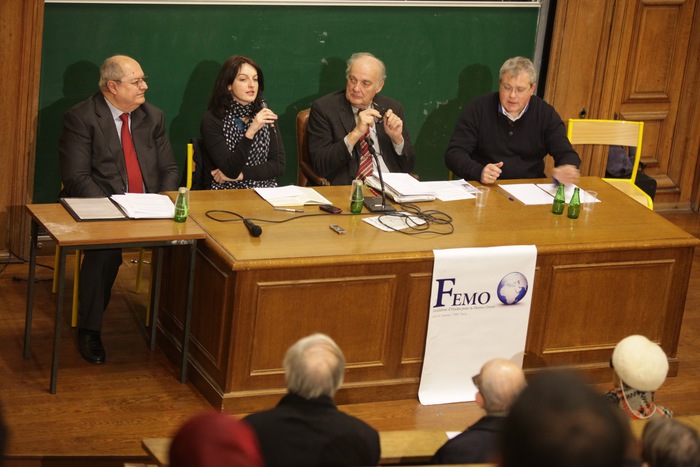
Conference at Université Paris I, Panthéon-Sorbonne
Where is the Middle East heading? Does the current chaos in Iraq and Syria have a solution? What might be the alternative to the de facto break-up of Iraqi territory? Should Iran be part of a solution? These are among the questions raised since the summer of 2014 by the emergence of a transnational Islamic State (ISIS/Daesh), addressed at a conference organised by IMAF and the Africa Master’s programme at Université Paris 1, with FEMO’s participation. With: Pierre Vermeren, historian, Professor at Paris 1 specialising in the contemporary history of the Arab world; Myriam Benraad, PhD in Political Science from Sciences Po Paris (Arab and Muslim World programme); François Colcombet, President of the Foundation for Middle East Studies (FEMO); and Djalal Ganjei, Shia Muslim dignitary, chair of the Freedom of Worship Committee of the National Council of Resistance of Iran.
Shifting Alliances and the Temptation of a New Order in the Middle East — by Pierre Vermeren
On 5 February 2015, a conference organised by FEMO in collaboration with IMAF and the Africa Master’s programme of Université Paris 1 was held at the Sorbonne on the theme “Where Is the Middle East Heading? Does the Current Chaos in Iraq and Syria Have a Solution? Should Iran Be Part of a Solution?” Pierre Vermeren, historian and Professor at Paris 1 in the contemporary history of the Arab world, addressed “Shifting alliances and the temptation of a new order in the Middle East: some post-war perspectives…” (VIDEO)
In his remarks, the author of “Idées reçues sur le monde arabe” (Le Cavalier bleu, 2012) stated: “The Iraqi question is only one facet of the vast Middle Eastern question, in both its historical and regional context. For 40 years now, since 1975, the Middle East has been struck by rolling wars, wars of mass destruction that never seem to end and which, if anything, appear to be spreading. The wars of 1948, 1967 and 1973 were relatively brief, confined to a very localised space, in a conflict whose complex political and diplomatic dimensions were intertwined.
Today we have chosen to focus on Iraqi affairs and, more broadly, on the great Eastern Question as it re-emerged at the end of the Cold War. The Cold War had in fact been comparatively stable in the Middle East compared with other regions of the world, Asia in particular. It was chiefly from 1979 onward that the region’s fragile stability disintegrated — the Iranian revolution being, of course, the definitive end of the Baghdad Pact.
That marked the entry into a state of war stretching from Lebanon to Afghanistan: the Lebanese war, lasting until 1990, which killed between 130,000 and 250,000 people; the Iran–Iraq war of 1980–1988, which killed between 500,000 and 1.2 million; the Soviet war in Afghanistan, which killed 1.25 million; the second Afghan war (2001–2014), which killed at least 100,000; the first Gulf War of 1990–1991, which killed between 150,000 and 250,000; the second Gulf War of 2003–2011, with the fall of Baghdad, killing at least 170,000; and then the Syrian revolution, turned civil war, which had already killed more than 200,000 — not to mention the Islamic State’s rise since last summer.
This terrifying toll of Middle Eastern wars can today be estimated at 3 to 4 million deaths — that is, roughly 100,000 deaths a year for 40 years. This is comparable to the very greatest conflicts in history; there are in fact few equivalents. Some six countries — Syria, Iraq, Lebanon, Kuwait, Iran and Afghanistan — have paid this dramatic and considerable toll.
A potential for violence such as, fortunately, has rarely been seen in history — martial violence, ideological violence, with multiple effects, notably effects of dehumanisation.
The extreme violence currently staged by Daesh is the fruit of these decades of extreme violence, unleashing a cumulative effect of devastation across entire countries — Lebanon, Iraq, Afghanistan, Syria today — and the destruction of human, cultural and religious communities, the destruction of cities, and the destruction of heritage of every kind, human and material alike.
So from the ‘Cold War order’ we have ultimately arrived at a kind of strategic chaos, bounded rather by America’s remaining allies — Turkey, a NATO member, Saudi Arabia and its Gulf satellites, and Egypt.
Systems of alliances
A crisis that began in 2014 has reached a kind of climax, since, fundamentally, the conflicts in Iraq and Syria have become the planet’s battlefields owing to the parties involved and the various systems of alliances at play. Not only is this a war of global, planetary dimensions because of these alliances, but it is also an enclosed arena of several superimposed wars: there are Cold War-style alliances… there are wars of religion — between Sunnis and Shias — but fundamentally ethnic and religious cleansing affecting various communities; there is a civil war in Syria, and indeed also a civil war in Iraq; there is a civil war within Sunni Islam; there is a war of Kurdish liberation; there is an ongoing strategic reconfiguration of the Middle East; there are wars waged by Alawite minorities and against certain minorities; there are old Arab-Persian rivalries in the background; there is Turkey’s power politics, and even the power politics waged by the Islamic Republic, and so on.
This shows just how difficult it is to have a strategic vision, since we are dealing with a layered war with numerous fronts. It is not only difficult to conceive of all these fronts at once, but also to find any coherent logic to them; so we must talk about human beings, we must try to picture things. We can picture things on a human scale, for example, with the Iran–Iraq conflict of the 1980s — a conflict one can mentally frame, that one can picture as a conflict between Sunnis and Shias. But these are only parts of a truly considerable puzzle.
I would simply like to return to the start of the Syrian conflict in 2011, at the time of the Arab Spring. Today’s conflict, which concerns us both in Syria and in Iraq with Daesh — this conflict at the heart of current Middle Eastern preoccupations — was set in motion just as the American war in Iraq was ending in 2011. It restarted in the form of the Syrian revolution within the context of the Arab Spring, and ever since we have been on a rather wild trajectory.”
The Conditions for the Emergence of Extremism in the Form of Daesh — by Myriam Benraad
Myriam Benraad, research associate at the Centre for International Studies and Research (CERI–Sciences Po) and at the Institute for Research and Studies on the Arab and Muslim World, spoke on 5 February 2015 at a conference organised by FEMO on the theme “Where Is the Middle East Heading? Does the Current Chaos in Iraq and Syria Have a Solution?” In her address at the Sorbonne, the author of “Irak, la revanche de l’Histoire” developed her reflections on “the conditions for the emergence of extremism in the form of Daesh in Iraq and Syria.” (Video)
(Excerpts:) “A little history: in 2004, the jihadist who would come to lead the hard core of the Iraqi insurgency was a Jordanian, Abu Musab al-Zarqawi, known since the 1990s for having rubbed shoulders with a number of major figures of international jihad, including Bin Laden and others. He entered Iraq in 2003 via Kurdistan and took command of the Iraqi branch of Al-Qaeda in Mesopotamia, pledging allegiance to Bin Laden and becoming the United States’ public enemy number one in Iraq.
In practice, Zarqawi surrounded himself with a number of Iraqis and took part in the two battles of Fallujah in 2004 against the American army. Fallujah, a city in western Iraq, would become the symbol of ‘Iraqi martyrdom’ in the face of the American occupation, as the city was razed almost entirely. It pitted these bogged-down American troops against these insurgents, and at the time, Zarqawi, together with a number of Iraqis, led the armed struggle.
The year 2004 is particularly symbolic, because it was ten years before the Islamic State’s offensive began, in January 2014, in the city of Fallujah. We have talked a great deal about the fall of Mosul in June 2014, but in reality the confrontation began in January in Fallujah — that same city razed by the American army. The other message in this offensive was clearly: ten years later, we have not forgotten, and we are back!
I titled my book ‘the revenge of history’ because, in reality, the Islamic State is replaying history. Its aim was to draw the Americans back onto Iraqi soil, with this whole notion that the score had not been settled. I recall Obama’s words at the time: ‘We are leaving behind a sovereign, representative and stable state.’ In reality, however, there is a deep crisis that was never resolved, including on the military front.
In June, Mosul fell into the hands of the jihadists — also a highly symbolic city, being Sunni and conservative, one that bore the brunt of the American occupation as well as the policies of the Iraqi government. Since 2003, Baghdad has had a majority-Shia government made up of former opponents of the Baath party and of Saddam Hussein, including a number of Islamist parties with direct ties to Iran, who were installed in power by the United States in 2003. With the Americans’ blessing, they embarked on a policy that amounted to — or at least was experienced as — anti-Sunnism by many Sunnis on the ground, which also fuelled the rise of the hardline Salafist fringe: the same Salafists who consider Shias to be infidels, and who saw these very Shias come to power in Baghdad on the back of American tanks.
The revenge
So here we have a symmetry between adversaries. Indeed, as early as 2004, Zarqawi declared that ‘the Shias are, just as much as the Americans, our enemies in Iraq.’ This marked an evolution in the struggle, because initially the primary adversary was the Americans, and from 2004 onward Zarqawi sectarianised the armed struggle, declaring that Iraq had become an outpost of Iranian hegemony in the region, with this impious power installed in Baghdad with American help, and that it therefore had to be overthrown.
The revenge that came ten years later is, first, a military revenge. It is experienced as such by Sunnis who bore the brunt of American military operations in the region, who were hunted down under the de-Baathification campaign aimed at ridding the country of the Baath party and its representatives. In practice, this translated into extremely fierce military campaigns in these very Sunni regions that are today under the control of the Islamic State. And, from the Salafist perspective, it is also the military reconquest of the domain of Sunni Islam — orthodoxy in their eyes, the only possible path, modelled on the historical military conquests of the Prophet’s first companions in this same region.
So all these atrocities, this ultra-violence being deployed, are meant to answer, in effect, the American ‘blitzkrieg’ of 2003. To these particularly virulent operations, to this humiliation, an ultra-violent military conquest is deployed in response, designed to leave a mark on people’s minds. We saw this with the fall of Mosul in June, and then with the atrocities committed against the Iraqi army, soldiers summarily executed in mass graves. A number of symbols were sent out, all conveying the Islamic State’s message: ‘we are the new conquering army that fears nothing.’ The idea, by drawing in Westerners and Americans, was clearly to go straight to a fight to the death with the West, and the United States in particular. This is not a logic of negotiation — we saw that with the Japanese hostages, we saw it with the Jordanian pilot who was burned alive. All of that is bluff. The Islamic State’s followers set out for a fight to the death.
The symmetry
The second revenge is political. Because, as the very name of this organisation — ‘the Islamic State’ — indicates, it is nothing less than the negation of everything that has been built since 2003: this state rebuilt under American tutelage, with a number of former Shia and Kurdish opponents in power. All of that is swept aside with a wave of the hand, and a ‘legitimate Islamic state’ is created for Sunnis — those very Sunnis who were stripped of power, humiliated, marginalised, and so on. This is the prelude to the restoration of the Caliphate. Another symbol: Abu Bakr al-Baghdadi. Abu Bakr was the first caliph in the history of Islam. On 29 June, from the Great Mosque of Mosul, he proclaimed the restoration of the Caliphate, denying colonial borders, denying existing states and the political regimes in place — regimes that are, once again, ‘allied with the West’ or ‘infidel regimes,’ whether Jordan, Saudi Arabia or Egypt: all of this must be swept away. Beyond the political revenge, there is also an economic revenge, which is discussed less. This entire war economy set up by the Islamic State, with oil smuggling, the whole system of extortion, the imposition of its own taxation in conquered territories, the takeover of local agricultural activity, and so on. All of this is also a way of saying: what we were dispossessed of, we are taking back by force! (…)
So that is why I believe we are truly facing a very complex problem, and I will end by saying one thing: insofar as the Islamic State has centred its entire narrative on these notions of humiliation and revenge — and I wrote an op-ed in Libération on this — we are touching on something universal when we touch on this type of emotion. So it was, in the end, not surprising to see young people in our own societies — who themselves suffer, who feel humiliated, marginalised, oppressed; when you are in the realm of emotion, you are in the realm of the universal — drawn to a group with this propaganda machine, these ultra-sophisticated films that also offer the modern ‘great adventure’ to young people who are dissatisfied or in crisis for various reasons. This is why we now have more than a thousand French nationals in the ranks of the Islamic State — because this Islamic State promises precisely a horizon, a revenge on life, and so on. And this is truly central to the jihadists’ narrative.
This explains why we have moved into a genuinely different stage of jihadism today, with the availability of French- and English-language content online, an offer of radicalisation from a group that is highly sophisticated and coherent in what it says, in its use of symbols — very powerful symbols, such as the ‘Guantanamo orange jumpsuit.’ The first architects of this propaganda today are, in fact, Westerners. We know that Westerners play an instrumental and extremely important role.
So we have in fact moved beyond the usual, traditional configurations; we have entered another world, and we can expect a long, drawn-out battle on the ground, but also ideologically — because this is now regarded as ‘a just cause’ by a number of individuals, and as ‘the great adventure of the modern world,’ whatever moral judgement one ultimately makes of it. Obviously, we hold a very negative moral judgement, but we must still question this systematic symmetry that is drawn between the barbarity attributed to them and the symbols of ‘our own barbarity.’ It must be said — this is significant, it is not a residual phenomenon.”
The Roots of Islamist Fundamentalism — by Jalal Ganjei
On 5 February 2015, a conference organised by FEMO in collaboration with IMAF and the Africa Master’s programme of Université Paris 1 was held at the Sorbonne on current issues affecting the Arab-Muslim world. Djalal Ganjei*, a Shia Muslim dignitary and chair of the Freedom of Worship Committee of the National Council of Resistance of Iran, addressed “The roots of this Islamist fundamentalism: is there a distinction to be made between Shia and Sunni extremism?”
In his address, Ayatollah Jalal Ganjei stated: “The Middle Eastern scene is characterised by chaos with unpredictable consequences. Yet, as a Muslim, I remain optimistic about the outcome of this confrontation, which will determine the fate of a quarter of the planet’s inhabitants.
Contrary to what is suggested in some media, we are not facing a conflict between Shia and Sunni fundamentalism. Both seek to gain power and impose sharia by force, and in this respect the principle of the Iranian Supreme Leader and Al-Baghdadi’s caliphate converge.
Sharia consists of a body of rules formulated 13 centuries ago, at the time of Islam’s territorial expansion. This expansion — whose model Al-Baghdadi seeks to revive — was accompanied by extreme violence, marking a founding break with the spirit of original Islam. Indeed, in the year 61 of the Hijra, the caliph massacred the Prophet’s grandson and those close to him. The following year, during a punitive expedition by the caliph against Medina — the Prophet’s emblematic city — his troops spent a week committing every conceivable atrocity; several thousand illegitimate children are said to have resulted from the assaults and rapes committed by the caliph’s soldiers. A year later, it was Mecca’s turn, then the centre of the movement of dissent, targeted by carnage that did not spare even the Kaaba, which was partially destroyed.
It was therefore at the time of Islamic expansion, and under particular historical and social circumstances, that sharia was formulated. This is why, when we study sharia, we find that, contrary to the spirit of original Islam, it is filled with discriminatory, misogynistic and intolerant precepts, and seeks to impose itself by the power of the sword. The Shia and Sunni versions of this sharia have no substantive ideological or practical differences. Their particularities stem from centuries-old rivalries for power. Both currents seek to impose sharia through the coercive power of the state.
Why is this manifesting in the 21st century?
One must ask why this crisis is manifesting itself in the 21st century. The answer must first be sought in the consequences of the First World War and the collapse of the Ottoman Empire, followed by the creation of artificial, patchwork countries such as Syria, Iraq and Lebanon, as well as the outbreak of the Arab-Israeli crisis and the successive wars that have mired the region in endless crises. It was in this context that an idea emerged to heal the ills of the Muslim masses: to revive the caliphate and Islam’s past greatness. This superficial and simplistic school of thought paid little attention to the social and economic developments of the preceding 14 centuries. This tendency was, at one point, so pervasive that the British even considered proposing King Fuad, Egypt’s last sovereign before Nasser, as caliph of the Muslims. This plan, however, failed thanks to the vigilance of Egyptian intellectuals and part of the Al-Azhar establishment. Elsewhere, there were attempts to install as caliph a certain Imam Yahya, religious leader and King of Yemen before the country’s republic was proclaimed. It was in these circumstances that Baathist and Nasserist governments took power in Arab countries, and the hope of creating a caliphate then faded.
But a turning point came with the establishment of the Islamic Republic in Iran. It gave Islamist groups the inspiration and the plausible prospect of creating their own caliphates. From the very start of the mullahs’ seizure of power in Iran, numerous groups, including representatives of the Sunni Muslim Brotherhood, came to congratulate Khomeini and seek his help in overthrowing the regimes of their own countries. These were not solely Shia groups.
Moreover, we know that under the constitution of the Islamic Republic, the regime is committed to assisting religious movements throughout the Muslim world. Several bodies were created for this purpose within the Revolutionary Guards (Pasdaran). Considerable budgets have been allocated, and bases have been set aside to train volunteers from various countries. Islamist groups, both Shia and Sunni, have thus been created across the region — Hezbollah, Islamic Jihad, Hamas, the Houthis, and others. Let us recall that the leader of the Al-Nusra Front in Syria (a Sunni group) has stated: even though we have religious differences with Iran, we are nonetheless not in conflict with it. It has also been established that the Iranian regime supported al-Zarqawi, the first leader of Al-Qaeda in Iraq — who later became today’s Daesh.
We can clearly see that this is not a Shia-Sunni religious conflict. Neither the Daesh phenomenon nor the Khomeini phenomenon has proposed any new interpretation of Islam that could be the source of conflict. On the contrary, their convergence of views leads them to want to impose, at bayonet point, a fundamentalist interpretation of Islam.
Here, one must regret the lack of discernment among Western policymakers, who failed to see this scourge coming. Driven by mercantile policies and narrow-minded views of the fundamentalist danger, they instead strengthened the fundamentalist regime in Iran. This gave hope to groups such as Al-Qaeda and Daesh that similar regimes could be created elsewhere in the region.
By contrast, it is worth noting that many Muslims — particularly in Iran and Iraq, where there is deep aversion to the Khomeinist project — are courageously fighting fundamentalist conceptions of Islam. In addition to the thousands of political prisoners tortured and executed in Iran for opposing the religious dictatorship, the entire Iranian people rose up in 2009 to demand an end to Islamist rule. The devastating consequences of this uprising for the regime remain palpable today in its gradual erosion and instability.
Why the optimism?
As we have seen, the solution to the problem of fundamentalism cannot be limited to a purely military approach. A broad international coalition has indeed responded to Daesh, which occupies vast territories and spreads terror through its cruelty. But this military mobilisation alone cannot overcome the expansionist potential of fundamentalist movements.
To eradicate Islamism, two decisive elements must be considered. On the one hand, the course of events will show that power based on a regressive, bloodthirsty sharia is a historically untenable phenomenon. On the other, any alternative — Muslim — force must carry a forward-looking message built on three elements.
First, it is important to return to the essence of original Islam and reject dogmatic sharia and any fixed, sacralised conception of dogma. As Prophet Muhammad himself encouraged, Muslims must always propose new solutions and pursue new paths. To address the problems of our world, one must rely on peaceful means to achieve equality and justice. This lies at the heart of ijtihad and the effort to interpret the founding texts — it is precisely this potential within Islam that fundamentalists shy away from, branding all modernity as apostasy and blasphemy.
Second, all coercion in religion must be banned. Imposing ideas by force is forbidden in Islam. Just as compulsory prayer and fasting are not admissible, a compulsory dress code is null and void.
Third, the principle of a religious state that allows one group to impose its hegemony over the other components of society must be consigned to the dustbin of history.
The beginnings of these changes are widely palpable across the Muslim world, especially in our own country, Iran. Yet the international community has a responsibility to open its eyes to this evolution. The ignorance of the past must be overcome, and purely mercantile policies abandoned. Otherwise, it will not only be the peoples of the Middle East who pay for these mistakes. The fatwa against Salman Rushdie already foreshadowed what was to come. The Charlie Hebdo massacre in France, similar attacks planned in Belgium and Britain, and those currently ravaging Africa, are all reminders that we are paying for the mess left by policies that sought to downplay the Islamist danger.
The best way to fight this dire phenomenon is to support the region’s democratic Muslims, particularly those fighting against the fundamentalism now entrenched in Iran.”
* Ayatollah Jalal Ganjei, who was a student of Khomeini in Najaf, Iraq, later fought against Khomeini’s ideas. He lost nine family members killed by the Iranian regime and was sentenced to death by Khomeini on religious and political grounds. He was notably one of the few Muslim religious dignitaries to condemn the death fatwa against writer Salman Rushdie.
François Colcombet: Where Is the Middle East Heading?
François Colcombet, President of the Foundation for Middle East Studies (FEMO), spoke on 5 February 2015 at a conference organised by FEMO on the theme “Where Is the Middle East Heading? Does the Current Chaos in Iraq and Syria Have a Solution?”
In his address, François Colcombet, a specialist on the Iranian question, stated: “Our meeting comes at an important moment. Current affairs in the Middle East and around the world are particularly pressing; the Arab world is in turmoil, and so is the Persian world. Iran plays an entirely central role, and the repercussions of the policies of the power currently in place — the power of the mullahs — across this entire region of the world and beyond are naturally of interest to experts, analysts, journalists and politicians, all those who will address you today.
Through the debates it organises, FEMO seeks to move beyond the often very superficial approach to the reality of tensions in the Middle East. In practice, we discover these problems only when they hit the news, and then forget what happened afterwards — the interactions between the crises in Syria, Iraq and Lebanon, and of course the role of an Iran that is omnipresent in each of these areas. We often hear the same ‘experts’ in the French media repeating the same analyses, which FEMO seeks to clarify by offering complementary — and sometimes contradictory — reflection to the usual presentation.
My great wish is to gain a better understanding of the reality of Iran, which matters so much to us. The French have never been directly involved in Iranian affairs — at the very least, they never attempted to colonise that part of the world. They have had relations of intellectual to intellectual, relations of curiosity, they have trained people… But above all, they discovered its positive heroes, important moments in its history, such as when, long ago, Iran attempted to draft a democratic constitution, in 1906. Mossadegh was a positive figure, a positive hero of Iran’s history — someone often cited, whose story was followed. And since then, this revolution has been followed, and ever since, all those who have tried to understand what is happening in that country have followed events closely.”
Click to watch the event video