
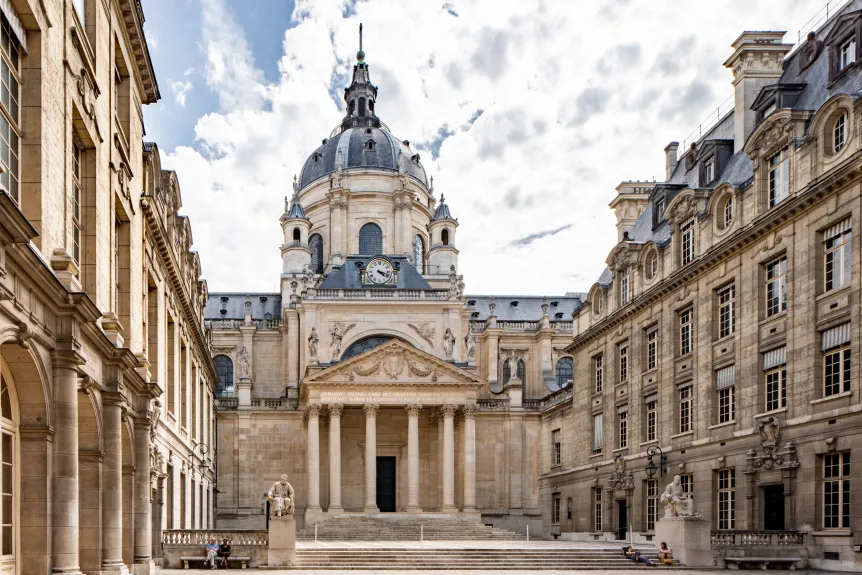
FEMO Conference at Université Paris I, Panthéon-Sorbonne
While current events were focused on acts of barbarity by organisations such as Boko Haram in Africa, the Foundation for Middle East Studies held a conference at the Sorbonne on the future of the Middle East and North Africa. At this conference, held on 15 May 2014, specialists spoke to shed light on this particularly turbulent zone stretching from the Maghreb to Iran, via Syria and Iraq.
The speakers examined regional and international interference to consider whether the influence of religious fundamentalism would ultimately prevail over the region’s popular awakening.
The optimistic note came from Professor Pierre Vermeren, historian, Professor at Paris 1 and a specialist on the Maghreb, who discussed the evolution of the Tunisian constitution and how Tunisian society and its key actors had so far managed to avoid violent confrontation, finding a path of wisdom in the compromise of this balanced constitution.
Turning to Iran, François Colcombet, President of FEMO, who has extensively studied the constitution of the Islamic Republic, argued that the reason this constitution remains blocked is the principle of the absolute power of a religious Supreme Leader — a block that forecloses any deep evolution of the Islamic Republic.
Bertrand Delais, documentary filmmaker and journalist, who recently wrote “Iran: un brasier sous les cendres” (“Iran: Embers Under the Ashes”), described Iran’s state of economic decay and an explosive social situation in which social networks remain a powerful force of mobilisation despite harsh repression. He concluded that the regime would not survive a crisis comparable to the 2009 uprising.
Yves Thréard, an editorialist at Le Figaro, analysed the West’s laxity in the face of fundamentalist dangers in the region, and was particularly critical of President Obama’s policy toward the Syrian and Iranian crises — an Obama who, in his view, failed to see the Arab Spring coming. He did, however, note a positive point in France’s engagement in the region, both under Nicolas Sarkozy and under François Hollande, particularly with regard to Africa. Yves Thréard believes Obama’s foreign policy will ultimately be judged by the standard of the negotiation with Iran.
Antoine Basbous, Director of the Observatory of Arab Countries, who highlighted the very real alliance between Assad’s Syria and the Islamic Republic, was particularly compelling on the suspect origins of the Islamic State of Iraq and the Levant (ISIL, known as Daesh in Arabic), whose leaders emerged from extremists released from Assad’s prisons precisely in order to sweep aside and discredit the moderate Syrian opposition.
Frédéric Encel, professor at ESG Management School and lecturer at Sciences Po, examined the Iraqi elections, stressing that Iraq is in a state of insurgency and poses a problem for Middle Eastern stability. Also critical of Obama’s policy, Frédéric Encel argued that in every crisis, Obama’s approach has been one of appeasement, without ever showing strength.
Former diplomat Nader Nouri, Secretary General of FEMO, closed the conference by highlighting the common threads between the Iranian revolution and the successive stages following the Arab Spring across the region. He noted a pendulum movement, between the co-opting of revolts by structured Islamist organisations and the reaction of the masses and secular movements. His closing remarks carried a message of hope, pointing to the emergence of a genuine cultural and ideological movement in Iran and across the Arab-Muslim world that stands as the antithesis of fundamentalism and pushes back against religion’s grip on power.
The Syrian Crisis and Iranian Influence — by Antoine Basbous
Antoine Basbous’s address at the FEMO conference: “I will begin by questioning the genesis, the mystery, of an alliance between a supposedly secular regime — the Baath in Syria — and an Islamic Republic that wants to export its revolution everywhere, including through Shia communities. In truth, this is a great deception: the alliance is very real, but it is built on concealment — meaning something is put on display as a lure.
In Syria, one cannot really say there is an Alawite regime in place; one should rather call it a secular regime — but behind this secularism, it is a small minority community that controls all the levers of power, especially everything related to security, the army, intelligence, and domestic politics. And on the other hand, this secular Syria found a way to become the foremost ally of the Islamic Republic of Iran. And when the opportunity arose — in 1980, when another Baath party went to war with the Islamic Republic, from 1980 to 1988 — the Syrian Baathist brothers openly became allies of the Islamic Republic of Iran, the only Arab country to do so.
There is, incidentally, a rather juicy episode: in order to bring the Alawites into mainstream Islam, an imam of Iranian origin who had settled in Lebanon, Imam Musa Sadr, issued a fatwa in 1972 — two years after Assad came to power — declaring that the Alawites were a branch of Shia Islam. The reality of this alliance is thus an alliance among various Shia factions stretching from the Caspian to the Mediterranean. Behind all this, we witnessed, in a neighbouring country then occupied by Syria — Lebanon — the emergence of Amal, a Shia party, then Islamic Amal, a more militant Shia party, and then Hezbollah. Hezbollah’s deputy secretary-general wrote a book (no longer available) in which he stated that it was in Ayatollah Khomeini’s office, in November 1983 — naming the eight people present — that Khomeini personally signed the decree creating Lebanese Hezbollah.
So we find ourselves with a fundamental alliance dating back to the Alawites’ rise to power in Syria, one that has only strengthened over time through a battery of strategic alliances extending through 2006 and 2007.
In 2005, Lebanese Prime Minister Hariri was assassinated — the first Arab tsunami, which unfortunately did not succeed. A third of Lebanon’s population took to the streets to demand the expulsion of the Syrian army. International pressure weighed in, and the Syrian army withdrew from Lebanon. At that point, the alliance held, but with the advantage shifting to Hezbollah — meaning the Iranian branch allied with Syria became the more decisive force in Lebanon.
But these allies quickly regained the upper hand with the 33-day war of July–August 2006, in which Hezbollah took the initiative in an attack on Israel and managed to sustain the war for 33 days. On the last day, as many missiles fell on Israel as on the first eight days combined. As a result, the Syrians and Iranians regained the initiative and reasserted themselves forcefully in Lebanon, managing to dictate their will.
By 2008, Hezbollah moved into Sunni Beirut, and having already seized control of Lebanon’s strategic affairs — security, defence, international relations — it went on to occupy West Beirut, the Sunni part of the city where many government institutions are located, and also threatened the Druze mountains, effectively declaring itself the sole power. This reality continues today.
We then arrive quickly at 2011 and the first Syrian tsunami, at which point this alliance burst into the open. We saw Iranian Revolutionary Guard generals declare that they would not let Assad’s allied regime fall. We heard Khamenei (the Iranian regime’s Supreme Leader) say that Iran’s very survival depended on keeping Assad’s regime in place. And we saw the Pasdaran, experts, weapons and munitions arrive — via Iraq by air or land, or via Beirut airport, which is entirely and exclusively under Hezbollah’s control, even if a few Lebanese army caps can be seen there simply for show. The pretext, on the Lebanese and Hezbollah side, was to defend threatened Shia shrines in Syria, notably that of Sayyida Zeinab south of Damascus, near the airport. At the same time, Iran’s involvement went beyond its own forces — notably through the Quds Force, led by General Qassem Soleimani, the regime’s strongman — I would say the number two figure in the Iranian regime. But Iran also sent many militias: Iraqi brigades such as Abu al-Fadl al-Abbas, Maliki’s men, and Yemeni Houthi Shias. In short, something of a Shia jihadist international alongside Assad.
What have we witnessed since 2011? The full commitment of three powers: Assad representing the Syrian regime; Russia, protecting Syria at the Security Council through its vetoes while sending weapons, munitions, logistical support and even experts; and Iran, committing financial resources despite embargoes and sanctions, along with the Pasdaran and every sort of pro-Iranian militia. All of this amounts to a scorched-earth policy.
The deeper strategy, as I see it, is this: I am convinced that the Iranian regime knows, deep down, that Assad’s regime is finished — it cannot be saved. So it tells itself: here is an opportunity to build, with Russia and Assad, a powerful, determined troika, unafraid, willing to use every means to succeed.
On the other side stands the camp of the weak — the Western camp — that brave and brilliant American lawyer named Obama, who makes promises, threatens, and then backs down, and a Western coalition of “Friends of Syria” that once numbered 111 states and is now down to 10 or 11 and shrinking. There is a fractured, divided, leaderless Syrian opposition without a clear vision. And above all, this alliance has created something monstrous: Daesh — the Islamic State in Iraq and the Levant. Daesh’s leaders were released from Assad’s prisons in December 2011. While those prisons were teeming with innocent people, Assad showed leniency toward the very jihadists he had once sent into Iraq to fight the Americans — because he needed them. So he put them back on the market, giving them a second life, a new assignment.
They were then joined by Iranian brothers — jihadists based in Iran. Recall this episode: in 2001, when the Americans attacked Afghanistan, Al-Qaeda split into two branches. One took refuge in Pakistan, the other withdrew into Iran. This Al-Qaeda-in-Iran branch, established there from December 2001 onward, was brought under the wing of the Pasdaran, becoming its subordinate branch, and was sent as reinforcement to help build Daesh’s strength in Syria. In 2012, it was further reinforced by 1,500 escapees from Maliki’s prisons in Iraq, who miraculously crossed 800 km of desert without being caught. And so this alliance between Assad and the Iranians conjured up its own best enemy — these horrific interventionist jihadist militiamen of Daesh — in order to completely sweep aside the moderate opposition and present the world with a choice between the ‘nice,’ ‘modern’ Assad and these horrific jihadist interventionists. It is an operation that deserves to be taught in war colleges as a case study in manipulation.
Today, I believe what is really at stake is not winning the war in Syria — because Syria is destroyed, and the destruction only worsens with each passing day. What is at stake is preserving a ‘useful Syria’ — a Syria that serves Iran’s strategy: a Syria with access to the coast, to the ports of Latakia and Tartus, and which, through this expanded ‘Alawistan,’ links up with the Bekaa Valley in Lebanon, Hezbollah’s stronghold. If this expanded Alawistan could permanently hold on to Damascus — which I do not believe is possible — that would be a bonus.
So today we are witnessing this alliance — combined with Putin’s well-understood interest in keeping the port of Tartus — moving toward the partition of Syria, within this expanded Alawistan. Already there is Syrian Kurdistan, there is the expanded Alawistan now in place, and what remains is the largest chunk of the country, left in undefined hands, which will have to be dealt with tomorrow.
That is the Syrian-Iranian alliance; that is Iran’s role in this Syrian tragedy, in this open-air slaughter unfolding in Syria.”
Iran: An Explosive Economic and Social Situation — by Bertrand Delais, documentary filmmaker and journalist
“My interest lies mainly in Iranian society. But let me start with an anecdote that I find very telling about this regime’s duplicity. Some of you may listen to France Inter — France Inter broadcast live from Tehran yesterday. You should know that France Inter had asked, back in 2009 at the time of the Green Movement, to broadcast live from Tehran, and that ever since, visas were systematically refused — a formal ban on coming to broadcast from Tehran. Then, three weeks ago, out of the blue, they were told they could come. And when the Iranians found out that one of the guests would be a representative of Tehran’s bazaar merchants — one of the regime’s current critics on economic matters — the mullahs’ response was to jam Iranians’ internet access to France Inter’s broadcast. In other words, Iranians in Tehran could not listen to France Inter yesterday, at the very moment the West was being offered a live broadcast from Tehran.
I tell this anecdote because it seems to me extremely telling of this regime’s duplicity.
In President Rouhani’s first term, there is the nuclear file and the embargo — why? Because there is a great internal peril, mainly for economic reasons. But when you dig a little into Iranian society today, into its state of decay, it is dizzying. In some respects, it can recall the end of socialist regimes — the ship is taking on water from nearly every side. That matters a great deal for what may happen next. Yet there is a political cynicism here that seems to me even greater than that which governed the socialist regimes. In some sense, the fact that the Supreme Leader played the Rouhani card is highly symptomatic — a bet on the system’s possible survival — even as the social reality becomes, from this standpoint, increasingly explosive.
Why ease the burden of sanctions? An economist close to the regime recently produced an analysis that made waves in Iran, though little was said of it here, attempting to estimate the economic needs required to put the Iranian economy back on its feet. The figure came to 100 billion dollars — a third of Iran’s annual budget, a considerable sum. That is roughly the equivalent of the annual size of the shadow economy, meaning some 80 billion dollars flow into the shadow economy every year, and 100 billion is still missing.
Why does it need 100 billion? For several reasons. First, this is a country with a very strong expansionist drive, inherent to its very nature, yet deprived of much of its revenue by the embargo — so it continues a relatively costly policy of spending and political investment without the necessary revenue to sustain it.
Second, this is no longer a young country — it is a country of young adults, which matters demographically, and matters for spending too. When you have a great many young students, meaning young parents, they first have expectations for their children — there are more children — and more children inevitably mean greater needs, requiring infrastructure. This economic situation may also explain why the fertility rate has today fallen dramatically low in Iran.
So we have a situation of extremely strong demand, of economic needs that cannot be met. For two years now, social movements and repeated strikes have multiplied, accelerating over the past year. Rouhani’s election raised a form of hope, opening a Pandora’s box — and then nothing happened, because economically the country is simply not in a position to deliver anything. The regime is, in reality, cornered. This has produced, first, inflation in access to energy — especially given this year’s very harsh winter.
The third point is the necessary modernisation of the industrial base, which is in a state of considerable disrepair, mainly for lack of investment. State and quasi-public enterprises have begun making decisions that lead to layoffs, but there is no social safety net behind them, creating enormous social problems — riots and strikes. Since December, there have been regular strikes in factories and services across Iran — a cascade of strikes, starting in industry, then spreading to manufactured-goods sectors, and now reaching services.
This industrial obsolescence goes hand in hand with a lack of investment. Take gas, for example — a very telling case: the gas distribution network is entirely obsolete. At one of the largest facilities, the South Pars gas field, 18 extraction platforms were ordered in 2005 and are still not finished. So of the 25 extraction platforms planned for this gas production centre, the country is simply unable to supply gas to meet the whole of Iranian demand.
This is an incredible paradox: if the economy were to take off again tomorrow, the country would still be unable to meet demand, because the more an economy runs, the more energy-hungry it becomes, and the less able you are to supply that energy. Yet today there is not enough energy supply precisely because there has not been enough investment, because different political choices were made instead.
I would add that the real price of gas, its real inflation, was for a long time concealed by Mahmoud Ahmadinejad’s policy of massive subsidies given to households to help pay for energy. Those subsidies have since been removed — another factor explaining runaway inflation. Once public assistance is withdrawn entirely, you fall back on the law of supply and demand, and in a country that produces little, where supply is scarce but demand remains substantial, prices mechanically rise, and three-quarters of the population can no longer make ends meet. That is what is happening.
That is the first economic picture, with its social consequences for Iranian society. There is another dimension too, since this naturally creates a social problem requiring a political response. First, the new government tried to undo what Mahmoud Ahmadinejad had built — a policy of sweeping subsidies designed to nip any unrest in the bud, especially since 2009. To borrow a metaphor from a regime official: we had a car that crashed into a wall, and we pretended it was still driving. That, roughly, is where we stand today.
One consequence — which recently sparked significant unrest in Iran — was a basket of food distributed to the most socially exposed, the poorest, to help them get through winter. Riots broke out in nearly every major city — Isfahan, Qom, Tehran. This is very telling, because this basket, which Iranians called ‘the basket of shame,’ reveals two things about today’s Iranian reality: first, Iranians who were used to a certain greatness for their own country found it deeply insulting to be given a food basket — imagine if all French people had to go to a soup kitchen; there is something of that order here. It was experienced as something shameful, generating social anger, frustration and protests.
And in other cities — generally the poorest ones, where people might otherwise have accepted the mediocre quality of the goods — many Iranians felt the distribution of these baskets was deeply unequal: as if by chance, the regime’s loyalists ended up with the best baskets, or somewhat fuller ones, while others received noticeably less.
Having travelled to socialist countries in my youth, this is what one experienced at the end — it recalls Ceaușescu’s Romania, the distribution of baskets… Each time, one has the impression that every social event carries within it a kind of spark ready to ignite. Everything is in an incredibly explosive situation.
This story of the basket matters. I mentioned 80 billion earlier — that is the estimated size of the shadow economy that mainly benefits the Pasdaran and a handful of regime loyalists. Generally, wherever an embargo exists, it always ends up benefiting someone — here, it benefits certain people all the same.
That is today’s reality. There is a clear pauperisation under way, and the regime is well aware of it — you can see it in Mahmoud Ahmadinejad’s thoroughly clientelist, populist economics. He lavished attention on the Pasdaran and on Iran’s most vulnerable populations alike, in an entirely clientelist game. The trouble is that this has now been halted — first because it was incredibly costly, and second because it created extremely sharp divisions within the regime itself. So a more conventional policy has taken hold. Except that as soon as Rouhani began adopting relatively conciliatory language to court American goodwill, he ran into fairly harsh pushback internally from the Pasdaran. It quickly became a matter of political balancing: presenting an extremely modern image on one side, while satisfying the regime’s hardest-line elements on the other, in order to also preserve social peace.
So what was taken away with one hand is today being given back with the other. In the end, the savings expected from scrapping Ahmadinejad’s sweeping subsidies are simply being redistributed differently. And people are starting to find it intolerable that banks lend at zero interest to regime friends while charging 25% or 30% interest to anyone not affiliated with the Pasdaran, and so on.
I could multiply examples endlessly, but that is indeed how things work — and from this standpoint, nothing has changed, even though people believed, at one point, that it would.
So there is now a genuine pauperisation of the middle classes taking hold. Beyond this clientelism — another point on which a parallel with socialist countries can be drawn — there is one area in which the Islamic revolution did not have a particularly negative effect: literacy and education levels, which have risen considerably over 30 years. So we find ourselves facing a population that is today educated, that has studied, and that finds itself without hope, without prospects. That is naturally, socially, explosive — because these people studied, made sacrifices, moved to the cities, sometimes left the countryside hoping to achieve something, and in the end achieve little or nothing. That is extremely dangerous.
One final element, which threatens Iranian society as it threatens many emerging countries, is the ecological threat — a very significant threat to Iranian society. At some power plants, for instance, so much water has been pumped from aquifers that entire rivers have dried up today, creating irrigation problems and completely upending the ecosystem. On this point, for the first time, a comprehensive FAO report came out three weeks ago, echoed in France by Courrier International, showing that Iran is indeed one of the countries whose internal ecosystem is most under threat today.”
And one can wager that if Iran manages tomorrow to climb out of its economic slump, it will once again become energy-hungry, in a country utterly unprepared for greater energy consumption — and this is likely to accelerate the ecological crisis it is already on the brink of.
“That is what I wanted to say about Iranian society. As you can see, it is not a very reassuring picture. And I would add that, generally, when you have an increasingly educated population with no hope, it is always extraordinarily dangerous, socially, for the regime — as happened notably in Tunisia. It happens every time. But it is even more dreadful when you have a political power that feels cornered and displays obvious, well-documented totalitarian reflexes.”
The Iranian Regime’s Influence on the Spread of Islamism — by Yves Thréard, journalist at Le Figaro
“Iran is a country I am fond of. When the revolution broke out in 1979, I had just returned from that country. This evening I have been asked to answer a vast question — if indeed it can be answered: what is the influence of the Iranian revolution, of this Iranian regime, on the spread of Islamism around the world?
I don’t know if you remember, but I have a very precise memory of 1979 — 35 years ago now — when Ayatollah Khomeini arrived in Tehran. I have an even more precise memory of the days before his arrival there, when he was staying in a town in the Yvelines called Neauphle-le-Château, where everyone went to visit him with such deference, and, I would say, such curiosity too. In 1979, nobody really knew what an imam was. We knew who the Shah of Iran was, and more or less knew that the Shah was not always gentle with his people — we had watched his imperial coronation on television. But Imam Khomeini received every courtesy — from the French authorities, for good reason, and he was visited and praised by Michel Foucault. But what I remember most is a visit by a neighbour of mine, Marguerite Duras, for a newspaper called Libération — Marguerite Duras conducted an interview with Imam Khomeini. Of course, at the time, we no doubt sinned through naivety, we were fairly ignorant, and we had no idea of this regime’s true intentions — intentions of liberation for a people, but intentions that turned out not to be ‘liberating’ for the Iranian people at all.
I heard the comparisons Bertrand Delais drew earlier with the Soviet regime — an easy comparison, but after all, Lenin was in Paris before making his revolution in Moscow, and Ayatollah Khomeini was in France before going to make his revolution in Iran, where he did not even need to fight, since the regime collapsed on its own… The Soviet communist regime lasted 70 years — how long, forgive the shorthand, will the Iranian regime last? That is the question everyone is asking today.
I would also like to say — because I did some research and went back to look at what Ayatollah Khomeini had said and declared upon coming to power in 1979 — that he indeed had the ambition to seize power in his own country, perhaps through rhetoric, claiming to liberate it, but he also had an expansionist ambition toward the entire world — not only the Arab or Muslim world, but the whole world — because this was, of course, the revenge he sought against the West, against the Great and Little Satans. I found declarations about this triumphant Islam that would defend the Quran against the infidels of the West. And there are also statements from certain Western leaders: an Israeli, Moshe Dayan, said precisely when Ayatollah Khomeini arrived in Tehran: ‘It’s an earthquake — see you soon!’ Moshe Dayan, who in fact died two years after Khomeini’s arrival in Tehran, seemed to be saying — and this reading holds up in hindsight — ‘see you soon,’ but forever! And when war broke out between Iran and Iraq — with Iraq starting that war, incidentally — Mitterrand uttered this line: if we do not support Iraq, the wind of the Islamic revolution will reach the Atlantic Ocean. This shows that, at the time, everyone was aware the danger was real, and that this expansionist danger, carried in Ayatollah Khomeini’s diatribes — very sober in tone but very heavy in substance — represented a danger to the world. Hence the danger to the West, but also to part of the Arab world, which is also why Saddam Hussein went to war against Iran.
Now, of course, you might say: how can we talk about the spread of Islamism while forgetting certain things? First, that Iranians are Persian, whereas the vast majority of the Muslim world is Arab — hence a duality, a rivalry. Second, that on one side you have Shias, a minority, and on the other, Sunnis, who form a large majority of the Muslim world. Yet, looked at closely, this opposition is ultimately quite relative on a fundamental level. It is probably very strong politically, but much more relative fundamentally, because the differences are essentially less doctrinal than dynastic.
On that basis, if we distinguish between populations and regimes, we can say that the embodiment of an Islamic regime that Tehran represented at the time exerted a strong influence on Arab populations neighbouring Iran — because they saw in it, perhaps, a reflection of what they themselves wanted, in opposition to the autocratic regimes governing them, regimes under which they often found themselves oppressed. That, of course, applies to Sunni countries, but also to countries with Shia majorities — Iraq being precisely such a case, where the majority of the population is Shia. And then there is Lebanon, with Hezbollah, which found in Iran a reason to fight and make itself heard that it could not otherwise have had. This shows that the regime, once installed in Tehran, harboured expansionist ambitions and also intended to serve as a force of resistance, asserting itself against a Saudi Arabia it considered far too subservient to the American ‘Great Satan.’
This expansionism has had terrorist and military expressions — no need to elaborate on Hezbollah, in Lebanon and beyond — since the idea, for Iran, was to strike out in self-defence against its own domestic opponents, and the Iranian resistance movement paid dearly for this. It also meant protecting itself by striking against Western forces, notably the United States and France. We remember the 1983 Beirut bombings. And I even noted — I was quite astonished by the sheer number of attacks in Paris in 1985 and 1986, likely carried out by Hezbollah: between February 1985 and September 1986, there were ten attacks in Paris almost certainly committed by Hezbollah, with Fouad Ali Saleh not far off.
I also wanted to discuss these demonstrations, this stoking of the Muslim community to ‘whip up’ its Islamic sympathies. Iran made extensive use of this on two occasions of global scale, which allowed it to keep alive a flame very useful for sustaining its regime, as an example of political Islam — because that is what must be understood here. First, the Salman Rushdie Satanic Verses affair in 1989. In France, almost no one had read The Satanic Verses; in Algeria, almost no one had read The Satanic Verses; in the United States, almost no one had read The Satanic Verses — with all due respect to Salman Rushdie! So who whipped up this hysteria around the book? The Iranian regime, obviously. A second example, much closer to us, came in 2006 — remember the Danish cartoons affair, later picked up in France. These were instances of manipulation that were not local in origin. I looked into how this chain of events unfolded, and this hysteria originates precisely in Tehran — which is invariably the first to exploit such episodes.
The main point — one we keep hearing repeated today — is that political Islam has failed: it failed in Egypt, it failed in Tunisia… But if you think about it carefully, political Islam still exists — in Iran. So its work is not finished, and neither is Iran’s. Through the instrumentalisation of the nuclear weapon, and through other economic files, Iran has not finished exerting a very powerful influence, transcending Sunni-Shia and Persian-Arab divisions, across the world. That is what is genuinely interesting when analysing this regime — the first regime in contemporary history to be an Islamist regime, and one that today proudly claims that identity. Of course, you might mention Saudi Arabia… but that regime did not come to power through revolution. And that is what is worth noting today, in contrast to the West.”
Moving Beyond a Superficial Approach to Middle Eastern Tensions — by François Colcombet, magistrate, President of FEMO
The first in a series of conferences aimed at shedding light on current problems in the Middle East opened with an introduction by François Colcombet, President of FEMO, at a conference at the Maison de la Chimie:
“First, I want to say how honoured I feel to have been entrusted with the presidency of this foundation. My great wish is to gain a better understanding of the reality of Iran, which matters so much to us. The French have never been directly involved in Iranian affairs — at the very least, they never attempted to colonise that part of the world. They have had relations of intellectual to intellectual, relations of curiosity, they have trained people… But above all, they discovered its positive heroes, important moments in its history, such as when, long ago, Iran attempted to draft a democratic constitution, in 1906. Mossadegh was a positive figure, a positive hero of Iran’s history — someone often cited, whose story was followed. And since then, this revolution has been followed, and ever since, all those who have tried to understand what is happening in that country have followed events closely.
Our meeting comes at an important moment. Current affairs in the Middle East and around the world are particularly pressing; the Arab world is in turmoil, and so is the Persian world. Iran plays an entirely central role, and the repercussions of the policies of the power currently in place — the power of the mullahs — across this entire region of the world and beyond are naturally of interest to experts, analysts, journalists and politicians, all those who will address you today.
Through the debates it organises, FEMO seeks to move beyond the often very superficial approach to the reality of tensions in the Middle East. In practice, we discover these problems only when they hit the news, and then forget what happened afterwards — the interactions between the crises in Syria, Iraq and Lebanon, and of course the role of an Iran that is omnipresent in each of these areas. We often hear the same ‘experts’ in the French media repeating the same analyses, which FEMO seeks to clarify by offering complementary — and sometimes contradictory — reflection to the usual presentation.
Today we will try to address both the domestic and external dimensions of Iranian policy, and our speakers, all well-known names in the media and experts in their fields, will offer us valuable insight.”
Avoiding the Confusion Between the Iranian People and the Regime — by Frédéric Encel, geopolitical analyst
“The Iranian people are not the Iranian regime. I am struck, day after day — particularly in the academic circles I frequent quite regularly — by how often the Iranian people and the regime are confused, when the regime is in fact an authoritarian and dictatorial one, and is therefore in no way legitimate in claiming to represent the people it purports to govern.
The first point to recall is that in 1979 there was no electoral plebiscite — nor, indeed, any overall popular plebiscite in Iran in favour of Khomeini. Everyone here knows very well that a party such as the Tudeh Party, for instance, later banned of course — the Communist Party — was extremely significant both in the number and the determination of its members. Other political currents, most often of a democratic character or aspiration, were also very significant. But religion was instrumentalised for political ends. Khomeini played heavily on social issues, on the idea of a ‘new political offer’: ‘Try us, test us! We are politically untainted! We are truly close to the people, we are not corrupt!’
This current ultimately imposed itself by force and amid confusion. And the 1980 war, launched against Iraq, allowed this regime to play the same card every dictatorship in history has played: tightening national energies by pointing to the enemy and the foreign plot. This is nothing new! And since then, there has never been any plebiscite, never any democratic process that could lead us to believe today that this regime has been accepted, in any way, by the Iranian population.
The second, much more contemporary point concerns Iraq. There, the Americans made an absolute mess of things in 2003, quite concretely — and, naturally, this rebounded to Iran’s advantage. It was a divine surprise for the Tehran regime, which did not even need to intervene, since the Americans did the work for it. By destabilising Iraq and the region generally, Iran was handed an obvious opportunity — again, playing on the Shia majority in Iraq. Let me be clear: my point is not that Shia Islam itself is the problem. The problem is Iran’s instrumentalisation of it, positioning itself as the ‘religion-state,’ the ‘protector-state’ of an entire confession — something contested by many Iraqis themselves. Today, power in Iraq is indeed beholden to Tehran, but not all Iraqi Shias follow the line Tehran would like. We are dealing with genuine manipulation in Iraq.
My third point concerns Syria: there is growing evidence — no longer mere rumour, but authentic, substantiated fact — supporting a rather classic dictatorial calculation: the enemy of my enemy is generally rather my friend! The infamous ‘Daesh’ (ISIL), this radical Islamist organisation now playing a genuinely dangerous but real game against Assad, is in reality manipulated by Tehran and Assad. The enemy of my enemy is my friend — meaning that the opposition to Bashar al-Assad, whether democratic or nationalist, now finds itself trailed by extraordinarily violent terrorists who considerably hamper this Syrian opposition, because it gets lumped together with radical Islamists — behind whom stands an Iran seeking, through this very means, to prop up Bashar al-Assad.
Assad, who is not only a war criminal but a criminal against humanity — and he will indeed have to answer for his actions one day — cannot today be treated by Iran as though he were a rational, moderate actor in its Middle Eastern geopolitics and international relations. We are nearing three years of extremely harsh repression that subsequently turned into civil war, and war outright. We are talking about 150,000 deaths. In three years, the Middle East has witnessed something practically unprecedented, involving the use of prohibited weapons and systematic support — diplomatic, economic and military — from Iran.
Fourth point: Hezbollah, whose military wing has been designated a terrorist organisation by Europeans — Hezbollah, created by the Islamic Republic of Iran, again by playing on the social and identity-based resentment of Shias in southern Lebanon, a resentment one can perfectly well understand. Hezbollah played the social card — a classic move, since extremists are always the best at exploiting social grievances… We mentioned Munich earlier, during the cold Berlin winters of 1929–1931 — who was providing social relief then?… This is something truly fundamental. Today, Hezbollah, an offshoot and creation of the Islamic Republic of Iran dating from 1982–83, has carried out a number of acts of force — against France, which we remember all too painfully, and against civilian Jewish targets in Argentina, notably in July 1994. And this same Hezbollah today supports Bashar al-Assad’s regime with everything it has — body and soul. That is something that cannot simply be brushed aside. Iran has also supported other terrorist groups that were not necessarily Shia — the GIA, for instance, is not Shia. So destabilisation is played almost permanently.
Let me conclude with three points. I often say: beware of a cornered regime — I had occasion to say this quite recently at one of the round tables on this very topic: a cornered regime is a dangerous regime. And the Iranian regime is indeed cornered — which is precisely why it was forced to approach the West to try to get sanctions lifted. Hence our vigilance — Western, and French in particular — must be extremely sharp. A cornered regime very systematically plays the worst-case-scenario game: destabilising its surroundings in order to better cling to power.
Second concluding point: extremely active proselytism. As has been said, the problem is not Shia Islam itself — but one must understand that, on the side of the Islamic Republic of Iran, there is an extremely active drive to proselytise among the region’s Shia minorities, in an effort to unite them under its banner.
So many observers confuse the Iranian regime with the Iranian people that, 35 years on, I believe this can no longer be allowed to pass — for the reasons we have seen: the total absence of this power’s legitimacy, both with respect to its own people and to other governments. Today there is a sense that a new regime is in power, simply because there is a new president! This reflects either ignorance, or naivety, or bad faith — take your pick — to believe the regime has changed. No! The ideological, religious, military and police infrastructure of the Iranian regime has not changed since 1979. No doubt, for tactical or strategic reasons, the current president was chosen by Khamenei. What is certain is that we have a new government that lacks the essential prerogatives, which remain in the hands of the regime’s true chief, Ali Khamenei. This, it seems to me, is an extremely important point. Because if we fail to make this distinction clear beyond these walls, I believe we will be doing an extremely disservice to the Iranian people, whose desire for freedom, whose level of political awareness, whose level of sophistication, is incomparably higher than that of those who rule over them.”