
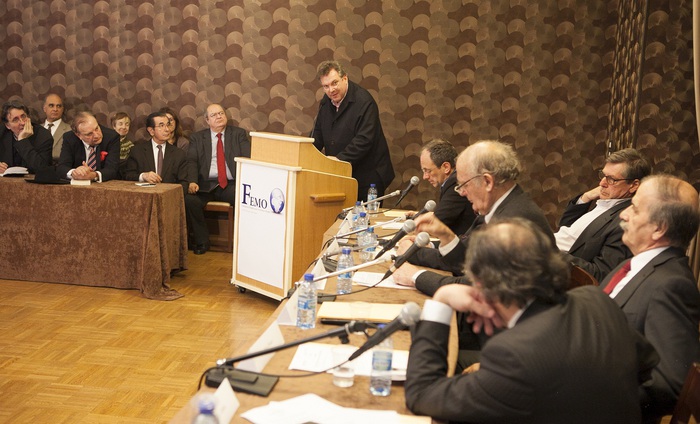
FEMO Conference, Maison de la Chimie, Paris
FEMO’s first conference was held on 11 February 2014 at the Maison de la Chimie, on the theme “35 Years After the Revolution in Iran: What Prospects?” The conference focused on the situation in Iran and the region 35 years after the revolution that brought Ruhollah Khomeini’s “Islamic Republic” to power.
Each speaker shone a spotlight on a particular aspect of current affairs: the nuclear negotiations in Geneva and their consequences, the sanctions imposed on Iran, the state of the country’s economy, regional conflicts, and Iranian influence…
FEMO organises a series of conferences aimed at shedding light on current problems in the Middle East. FEMO’s President, François Colcombet, explained in his opening remarks: “FEMO will try to offer complementary — and sometimes contradictory — reflection to the usual presentation.”
The speakers rather called for greater moderation in the media and diplomatic approach toward the current Iranian government. FEMO’s President, who has studied the Iranian constitution in particular depth, recalled that it grants absolute power to a religious Supreme Leader, permanently blocking any evolution of a regime that remains a prisoner of its own dogmas.
Sid Ahmed Ghozali, former Prime Minister of Algeria, shared his experience as a statesman dealing with the Iranian regime. The Islamic Republic’s conduct toward Algeria is, he said, a textbook case of the behaviour of a regime whose very nature is to impose itself on the Muslim world.
Frédéric Encel, professor at ESG Management School and lecturer at Sciences Po, criticised a tendency in certain circles in France to conflate the regime with the Iranian people. He also discussed the influence exerted by the Iranian regime across the Middle East, notably in Syria. Frédéric Encel particularly noted the objective alliance between extremist groups such as ISIL and the Syrian and Iranian regimes, highlighting that Iran supports not only Shia extremists but Sunni ones too across the region.
Yves Bonnet, Honorary Prefect and former Director of the DST (French domestic intelligence service), a leading expert on the Middle East and director of CIRET-AVT (International Centre for Research and Studies on Terrorism and Aid to Victims of Terrorism), discussed the sanctions regime and the nuclear negotiations. “Never,” he said, “have Western diplomats put the question of human rights violations in Iran on the table.”
Pierre Rousselin, foreign policy editorialist at Le Figaro, observed that in the nuclear negotiations, the powers are granting the Iranian regime far too much legitimacy, even as many problems — particularly Iranian interference in the region — remain unresolved.
Bertrand Delais, documentary filmmaker and journalist who recently wrote “Iran: un brasier sous les cendres” (“Iran: Embers Under the Ashes”), discussed the Iranian regime’s severe economic difficulties and a situation that could explode at any moment under the pressure of a society at breaking point and out of step with the values of the Islamic Republic.
Yves Thréard, editorialist, recalled that the rise of Islamist fundamentalism around the world dates back to the Islamic revolution in Iran. He cited episodes such as the Salman Rushdie affair, which initially went unnoticed but set the Muslim world ablaze after Ayatollah Khomeini sought to exploit it.
See the event videos