
By Maceo Ouitona –
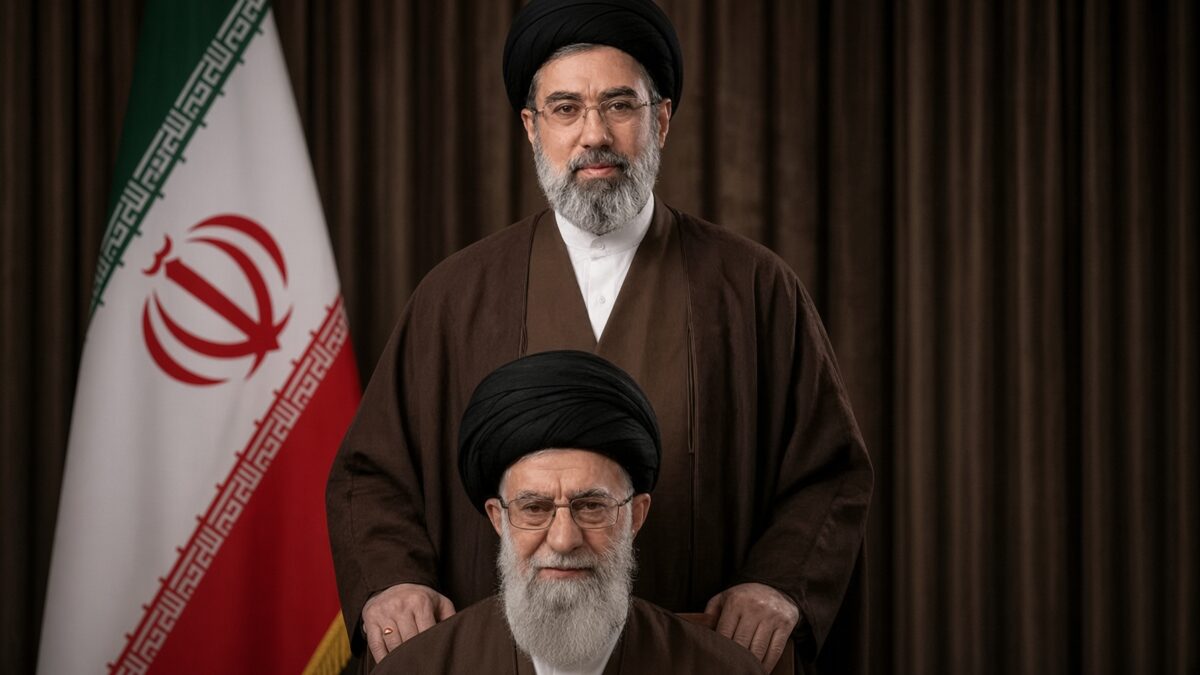
Since the death of Ali Khamenei in US-Israeli strikes on February 28, 2026, Iran has officially had a new Supreme Leader: his son, Mojtaba. Yet, six months after his appointment, he has still not made a public appearance. Meanwhile, the Revolutionary Guards and the Supreme National Security Council have taken on an increasingly prominent role in conducting the war and making major strategic decisions. The Islamic Republic has not turned into a mere military junta, but the true center of power has shifted slightly.
February 28, 2026, likely marked the most significant political upheaval experienced by the Islamic Republic of Iran since the death of its founder, Ayatollah Ruhollah Khomeini, in 1989. In the very first hours of the offensive launched by the United States and Israel against Iran, Ali Khamenei—Supreme Leader for thirty-seven years—was killed. Several high-ranking military and security officials also perished in the ensuing strikes. Yet, contrary to the hopes of those who envisioned a “decapitation” of the regime that might trigger its collapse, the state apparatus survived.
Eight days later, on March 8, the Assembly of Experts designated Mojtaba Khamenei—the late leader’s son—as the third Supreme Leader in the history of the Islamic Republic. On paper, institutional continuity was assured. In practice, however, something far more profound occurred: the office of Supreme Leader still exists, but the system no longer appears to be organized, as it once was, around a single man capable of unilaterally imposing his decisions on all other centers of power.
The question facing us today, therefore, is not whether Iran still has a government or even a Supreme Leader. It does. The challenge lies in determining where effective authority now resides within a system designed to operate around a supreme arbiter who has become all but invisible.
Ali Khamenei had built far more than just an office
The Iranian Constitution grants the Supreme Leader considerable powers. Article 110, in particular, empowers him to define the country’s broad policy directions, oversee their implementation, command the armed forces, declare war or peace, and appoint several key military, judicial, and institutional officials—including the commander of the Revolutionary Guards. In the event of a vacancy, Article 111 stipulates that a provisional council is to exercise his powers until the Assembly of Experts selects a successor.
However, explaining Ali Khamenei’s Iran solely through the Constitution would be insufficient. Over his thirty-seven years in power, the Supreme Leader had gradually transformed an already powerful office into the nerve center of a vast political, religious, military, and economic network. His office—the bayt—commanded an administration capable of intervening in virtually every sector of the state. The Revolutionary Guards reported directly to him, while officials loyal to him occupied the Republic’s key institutions.
Ali Khamenei himself had faced a difficult ascent to power in 1989. At the time, he lacked Khomeini’s religious authority, and the constitutional criteria for the office had been relaxed. A former president and long-standing member of the ruling establishment, he had gradually built up his own authority. Over time, no major center of power within the regime could successfully oppose him for long.
It is precisely this personal capacity for arbitration that is missing today.
Mojtaba Khamenei: all the powers on paper, far fewer in practice
Mojtaba Khamenei’s designation was not entirely unexpected. For several years, Ali Khamenei’s second son was considered one of the most influential figures in his father’s inner circle. He maintained close ties, in particular, with the security apparatus and the Revolutionary Guards (Pasdaran). Yet, unlike his father in 1989, he had never held a high-ranking public office that would have allowed him to establish his own political legitimacy. Nevertheless, operating in his father’s shadow, he oversaw the entire security apparatus.
The question of his succession also presents a delicate issue for the Islamic Republic. The regime born in 1979 was built in opposition to a hereditary monarchy; seeing a Supreme Leader’s son directly succeed his father inevitably fuels accusations of a slide toward dynastic rule. Formally, however, Mojtaba Khamenei did not inherit the position: he was selected by the Assembly of Experts, in accordance with the procedures established by Iranian institutions. Yet several sources interviewed by Reuters claim that the Revolutionary Guards …exerted a decisive influence in securing his appointment and overcoming resistance to his candidacy.
Another factor radically distinguishes Mojtaba from his predecessors: his physical absence.
According to several Iranian officials cited by Reuters, he was seriously wounded in the February 28 strikes that killed his father. By August 28—nearly six months after his rise to power—no recent photographs, videos, or audio messages of him had been released to the public. His interactions with the public were essentially limited to written statements read out by state media. He did not even appear at the funeral ceremonies held for Ali Khamenei in July.
Yet, authorities insist that he is governing. Masoud Pezeshkian, for instance, stated that he attended a seven-hour meeting with him on August 10. Iranian officials also say that he receives key reports and retains final decision-making authority on major issues. His invisibility is reportedly due to both his health condition and the fear of another assassination attempt.
This point is crucial: there is no evidence to suggest that Mojtaba Khamenei is merely a figurehead or that he has been completely sidelined from power. However, the circumstances under the which he performs his duties have profoundly altered the decision-making process.
The Revolutionary Guards at the heart of the new system
The primary consequence of Ali Khamenei’s passing is the dramatic strengthening of the Islamic Revolutionary Guard Corps (IRGC), or Pasdaran. This compounds the country’s state of perpetual conflict with the United States and Israel.
Yet, this trend did not begin in 2026. Established in 1979 to safeguard the revolution and the new regime, the Pasdaran have evolved over the decades into far more than just a military force. They control a significant portion of the security apparatus, play a decisive role in the ballistic missile program and Iran’s regional policy, command vast economic networks, and have seen many former officers assume major political roles. Even before Ali Khamenei’s death, the Council on Foreign Relations described them as one of Iran’s most powerful organizations.
The war has accelerated this trend.
In late April, several Iranian officials and sources familiar with internal deliberations told Reuters that while Mojtaba Khamenei remained at the formal apex of the hierarchy, he acted more as a validator of decisions than as someone who imposed them. Military strategy and key policy directions are now reportedly formulated by a much tighter circle comprising the Pasdaran (Revolutionary Guards), the Supreme National Security Council, and the Office of the Supreme Leader.
In other words, power did not vanish with Ali Khamenei; it became collectivized and militarized.
This shift is particularly evident in the prominent role assumed by Ahmad Vahidi, the current Pasdaran commander. A former head of the Quds Force and former Defense Minister, he is described by several sources cited by Reuters as a central figure in the conduct of the war. Parliament Speaker Mohammad Baqer Qalibaf—himself a former Pasdaran commander—has also gained influence as a liaison between the political, military, and security spheres.
The Supreme National Security Council: A New Operational Hub
However, one institution appears to have gained considerable importance: the Supreme National Security Council (SNSC).
Formally chaired by the President of the Republic, this council brings together the country’s top political, military, and security officials, as well as representatives of the Supreme Leader. It coordinates security policy and aspects of foreign policy. In Ali Khamenei’s Iran, it was already a key venue for policy preparation; however, the Supreme Leader’s authority ultimately served to resolve any disagreements. Today, the SNSC resembles the operational heart of a collective war command more than anything else.
The appointment of Mohsen Rezaei as the Council’s secretary on August 10 illustrates this shift. Rezaei is no technocrat; he led the Revolutionary Guards from 1981 to 1997, including during much of the Iran-Iraq War. His appointment by Mojtaba Khamenei may signal a move by the future Supreme Leader to take control of the body.
And what of President Pezeshkian?
Yet Massoud Pezeshkian is far from insignificant. Elected president in 2024, he is the country’s highest-ranking directly elected official. His government manages the economy, aspects of domestic policy, and day-to-day diplomacy. He also officially chairs the Supreme National Security Council. However, the management of the Council remains …in the hands of his secretary, who is the true leader.
However, the limits of the President of the Republic’s power become clear when the interests of the civilian government clash with those of the Supreme Leader or the security forces. In the spring, for instance, Pezeshkian angered the Pasdaran after apologizing to certain Gulf states affected by Iranian military operations—remarks he was subsequently forced to qualify.
Nevertheless, recent events have assigned the president an indispensable role. Faced with collapsing oil exports, soaring inflation, and the economic fallout of the war, his government must keep the state running on a daily basis and seek diplomatic compromises. In early September, Pezeshkian continued to advocate for a potential deal with Washington, provided the United States honored the commitments made under the arrangements negotiated in June.
Foreign Minister Abbas Araqchi also plays a pivotal role in negotiations with foreign powers. Yet neither he nor Pezeshkian controls Iran’s military apparatus; the Constitution places the armed forces under the authority of the Supreme Leader.
Has Iran become a military dictatorship?
It is tempting to conclude that the Revolutionary Guards have simply seized power. That, however, would be jumping to conclusions.
There has been no military coup. The institutions of the Islamic Republic continue to function: Mojtaba Khamenei remains the Supreme Leader, the Assembly of Experts exists, Pezeshkian’s government administers the country, the Parliament (Majlis) carries out its duties, and the clergy retains a central role in legitimizing the system.
It is therefore inaccurate to claim that we are no longer dealing with the “mullahs’ regime”: despite changes at the top, the nature of power and its core mechanisms remain fundamentally unchanged.
Above all, the Pasdaran themselves have no obvious interest in dismantling this structure. Historically, their power developed within the Islamic Republic, not in opposition to it. The office of Supreme Leader grants them a revolutionary and religious legitimacy that an openly military government would lack. A collapse of the system would deprive the Revolutionary Guards of their raison d’être, which is rooted in preserving the Supreme Leader’s supremacy. The transformation is therefore more subtle. Under Ali Khamenei, the Pasdaran were extraordinarily powerful yet remained subordinate to a leader whose personal authority surpassed their own. Under Mojtaba, the balance of power is not reversed. However, we are dealing with a weakened Islamic Republic led by a Supreme Leader who has yet to prove himself and whose physical absence from various conflict zones constitutes an additional weakness.
This marks the difference between a military junta and a theocratic regime where the center of gravity is shifting toward the security apparatus.
A more collective Islamic Republic, though not necessarily a more moderate one
This shift could have significant consequences for Iranian politics.
The first concerns negotiations with the United States. A leader with undisputed authority can sometimes make an unpopular decision and impose it on various factions. Ali Khamenei, for instance, authorized the negotiations that led to the 2015 nuclear deal (JCPOA) while remaining deeply hostile toward the United States. In the current system, any compromise would likely require the buy-in of a larger number of security actors whose legitimacy rests precisely on resisting Washington.
This collective decision-making process can slow down decisions and make compromise more difficult. Indeed, mediators involved in the talks have described to Reuters an Iranian process that is at times unable to respond quickly—a sign of the absence of a command center comparable to the one that previously existed.
The second consequence concerns domestic policy. The fundamental mission of the Pasdaran is to preserve the revolutionary system. Yet Iran is emerging from a period of mass protests and facing an extremely difficult economic situation. In a regime where security officials play an increasingly prominent role, the priority is less likely to be political opening than state survival and the control of protests. The historical role played by the Pasdaran and the Basij militia in suppressing anti-government movements sets a significant precedent in this regard.
Finally, the question of legitimacy remains unresolved. Ali Khamenei had thirty-seven years to transform an initially fragile authority into …personal domination of the system. Mojtaba Khamenei begins his reign wounded, invisible, challenged by a segment of the population, and dependent on a military apparatus whose influence has never been greater.
So, who actually governs Iran?
Six months after Ali Khamenei’s death, the answer is no longer found in a single name.
Mojtaba Khamenei governs, insofar as he legally holds the powers of the Supreme Leader and several high-ranking Iranian officials state that he continues to approve major strategic decisions. Yet, there is no indication that he currently exercises the kind of personal command that characterized his father.
The Revolutionary Guards also govern, as they control the military and security apparatus and possess political influence that is now essential to the regime’s survival. Their weight in Mojtaba’s succession and in the conduct of the war gives them unprecedented leverage.
The Supreme National Security Council governs, as it appears to have become the primary forum for forging strategic consensus among military leaders, politicians, and representatives of the Supreme Leader.
Finally, Pezeshkian, Qalibaf, Araqchi, Mohsen Rezaei, Ahmad Vahidi, and several other figures within the system participate—to varying degrees—in this new architecture.
Post-Ali Khamenei Iran is, therefore, neither a leaderless regime nor, at this stage, a simple military dictatorship. It has evolved into something more complex: a theocracy where supreme authority remains religious, but where power is exercised increasingly collectively around a security and military core.
Ali Khamenei’s death did not destroy the Islamic Republic. However, it removed the man who, for nearly four decades, was able to arbitrate among its various factions. It is still too early to tell whether Mojtaba Khamenei will be able to assert personal authority comparable to that exercised by Ali Khamenei over the regime’s various factions. Ali Khamenei himself began his tenure in 1989 with limited religious legitimacy before becoming the system’s undisputed center of power. However, his son faces a far more unfavorable situation: a protracted war, an economy in crisis, domestic dissent, and a lack of public visibility.
This may well be the most significant political shift in Iran since February 2026. The Islamic Republic has survived the passing of its leader. But will it survive the multiple crises looming on the horizon?
* Maceo Ouitona is a journalist and FEMO contributor; he translated Struan Stevenson’s book Dictature et révolution (published by Les Presses du Midi).