
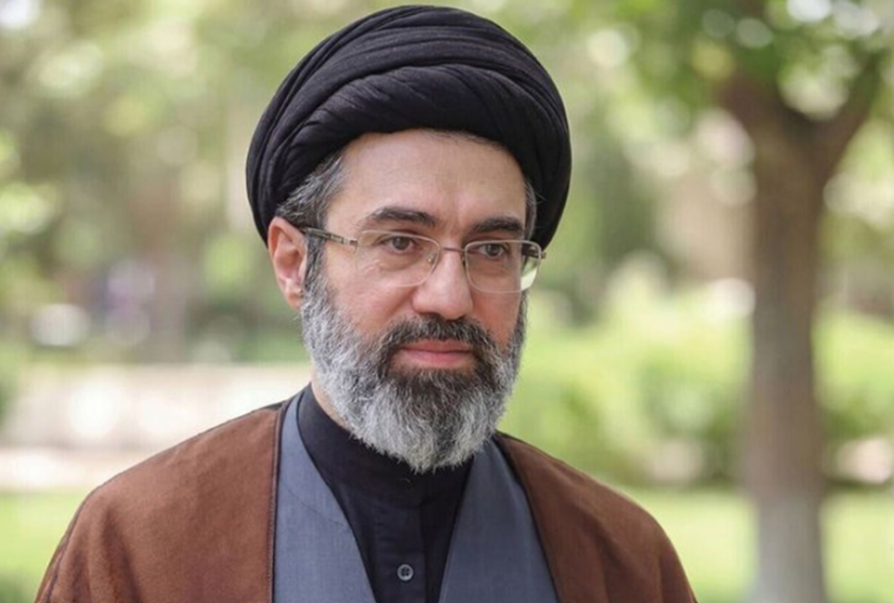
Textual Analysis of Mojtaba Khamenei’s July 26, 2026 letter to Naeem Qassem
Introduction
At the textual level, Mojtaba Khamenei’s message closely follows the ideological language traditionally used by the Islamic Republic in addressing Hezbollah and the broader Axis of Resistance. References to jihad, resistance, martyrdom, Palestine, and the legacy of Ayatollah Khomeini and Ali Khamenei are consistent with long-established official discourse.
What distinguishes this message is therefore not its ideological vocabulary, but its timing and political context. Considered alongside Mojtaba Khamenei’s previous public statements since the leadership transition, the message appears to contribute to a broader narrative aimed at consolidating the new leadership while reaffirming continuity in the Islamic Republic’s domestic and regional policies.
The analysis below distinguishes between what the message explicitly states and the broader strategic implications that may reasonably be inferred from its content.
1. Reinforcing the Relationship Between the New Leadership and Hezbollah
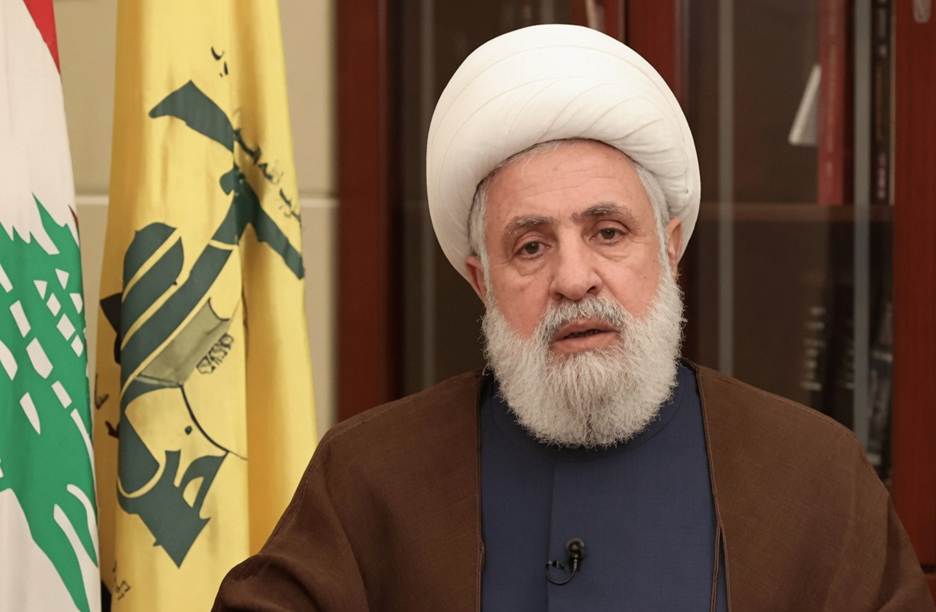
Hezbollah Secretary-General Naim Qassem
The message opens by welcoming Hezbollah Secretary-General Naim Qassem’s letter of allegiance and expressing appreciation for Hezbollah’s fighters. Mojtaba Khamenei refers to them as his “brothers and sons” and praises their loyalty to the ideals of former Islamic Republic supreme leaders Ruhollah Khomeini and Ali Khamenei.
The language combines religious symbolism with personal expressions of gratitude. Beyond its emotional tone, however, the opening section appears intended to reaffirm the organizational and ideological relationship between Hezbollah and the regime’s new leadership.
The significance of this passage lies less in its expressions of solidarity—which are largely consistent with previous Iranian rhetoric—than in the public nature of the exchange. The simultaneous publication of Hezbollah’s pledge of allegiance and Mojtaba Khamenei’s official response is consistent with an effort to demonstrate continuity following the leadership transition.
While this exchange does not by itself establish that every member of the Axis of Resistance has formally recognized Mojtaba Khamenei’s leadership, it provides a significant public indication that Hezbollah has done so. Given Hezbollah’s central position within the Axis of Resistance, this acknowledgment carries considerable symbolic and political weight.
The exchange may also be intended to reassure Hezbollah itself during a period of political transition.
2. Reaffirming the Ideological Framework of the Regional Conflict
The message portrays the United States and Israel as the principal sources of oppression and instability in the region before concluding that “there is no way left but jihad and resistance.”
Within the framework of the message, resistance is presented not simply as one available policy option but as the principal source of political legitimacy. The wording reflects the Islamic Republic’s longstanding ideological narrative, according to which resistance constitutes both a moral obligation and a strategic necessity.
This passage should primarily be understood as reaffirming ideological continuity rather than announcing a new strategic doctrine.
At the same time, the statement should not necessarily be interpreted as excluding future diplomacy. Mojtaba Khamenei’s earlier public messages have suggested that negotiations may remain acceptable under specific political circumstances. Taken together, these statements indicate a distinction between strategic principles and tactical flexibility.
Within this framework, resistance remains the permanent ideological foundation of the regime’s regional policy, while negotiations may be accepted as tactical instruments when presented as serving, rather than replacing, the objectives of resistance.
This distinction helps reconcile what might otherwise appear to be contradictory positions and reflects a pattern that has appeared repeatedly in the Islamic Republic’s political discourse over several decades.
And then, the language also serves a symbolic and mobilizing function rather than providing detailed guidance for future policy implementation. Iranian official discourse has frequently employed uncompromising ideological language even during periods of active diplomatic engagement.
3. Reaffirming Hezbollah’s Strategic Position
The message describes Hezbollah as the pioneer of the jihadi movements, an inspiration for free nations, a symbol of resistance against Israel, and the product of the sacrifices of the Lebanese people.
Rather than acknowledging recent military or political setbacks, the message places Hezbollah within a broader historical narrative of resistance and sacrifice.
This approach appears intended to preserve Hezbollah’s political legitimacy by emphasizing its historical role rather than its immediate circumstances. Temporary reverses are implicitly framed as episodes within a much longer struggle whose ultimate trajectory remains unchanged.
Such historical framing has long been a characteristic feature of Iranian revolutionary discourse. By presenting the resistance as a deeply rooted historical movement rather than a contemporary military actor alone, the message reinforces continuity despite changing regional conditions.
Interim Assessment
The first half of the message performs three interconnected functions.
First, it publicly reinforces the relationship between the regime’s new leadership and Hezbollah.
Second, it reaffirms resistance as the central ideological principle underlying the Islamic Republic’s regional strategy.
Third, it preserves Hezbollah’s symbolic status within that framework despite recent military and political challenges.
At this stage, however, the message remains primarily declaratory. Its broader strategic significance emerges more clearly in the second half of the text, where Mojtaba Khamenei moves beyond ideological affirmation to explicit statements concerning official policy, the conditions for any future regional settlement, and the relationship between deterrence and diplomacy.
4. Declaring the Regime’s Official Regional Policy
The most consequential passage in the message is the declaration that:
“Defending the Lebanese Mujahideen is the strategic policy of the Islamic Republic of Iran.”
The message further states that preserving Lebanon’s territorial integrity and bringing Israeli aggression to a complete end constitute essential conditions for any agreement intended to end the conflict.
Unlike the earlier sections, which primarily reaffirm ideological principles, this passage explicitly addresses state policy. It is therefore the clearest policy declaration contained in the message.
The statement suggests that official support for Hezbollah continues to be presented as a permanent element of the Islamic Republic’s regional strategy rather than as a temporary tactical choice. No indication is given that the leadership intends to redefine Hezbollah’s role or reduce its strategic importance.
At the same time, the message does not reject the possibility of future diplomatic understandings. Instead, it establishes conditions under which such understandings could be considered acceptable. Negotiations are therefore presented as instruments that may consolidate the achievements of resistance rather than replace them.
It is important, however, to distinguish between declaratory policy and policy implementation. The message clearly articulates the regime’s official position, but it does not by itself demonstrate how these principles will be translated into operational decisions. The practical application of these stated objectives will depend upon future political developments and strategic calculations.
5. Preserving Historical Continuity
The message pays tribute to Hassan Nasrallah, fallen commanders, and members of the resistance, comparing the movement to a deeply rooted tree whose foundations remain firm despite repeated attempts to destroy it.
This imagery reinforces one of the central themes of the message: continuity.
Rather than presenting the current regional situation as a turning point, the message situates recent events within a longer historical narrative extending from the Islamic Revolution through successive decades of confrontation with Israel and the United States.
The emphasis on historical continuity serves several purposes simultaneously.
It reassures supporters that recent setbacks should not be interpreted as strategic defeat.
It links the new leadership directly to the revolutionary legacy established by Ayatollah Khomeini and maintained under Ali Khamenei.
Finally, it reinforces the idea that the Axis of Resistance is defined by long-term historical endurance rather than by the outcome of any individual conflict.
This historical framing has been a recurring feature of Iranian revolutionary discourse and contributes to portraying the succession not as the beginning of a new political era but as the continuation of an existing revolutionary project.
Strategic Assessment
Consolidating Mojtaba Khamenei’s Leadership
Taken together, the message appears to serve a broader political purpose extending beyond Lebanon itself.
Its principal significance lies in the public confirmation of continuity between the previous and current leadership of the Islamic Republic.
The publication of Hezbollah’s pledge of allegiance alongside Mojtaba Khamenei’s response constitutes a significant symbolic event. It strongly suggests that Hezbollah publicly recognizes Mojtaba Khamenei as the successor to Ali Khamenei in his role as the supreme religious and political authority guiding the Axis of Resistance.
This conclusion should nevertheless be interpreted with appropriate caution.
The exchange demonstrates Hezbollah’s public recognition of the new leadership but does not by itself establish that every component of the Axis of Resistance has completed a comparable transition.
Further evidence from other members of the regional alliance would be required before drawing broader conclusions regarding the entire network.
Nevertheless, given Hezbollah’s central role within the Axis, this public acknowledgment represents an important milestone in the consolidation of Mojtaba Khamenei’s leadership.
Continuity of Regional Strategy
One of the most striking characteristics of the message is what it does not contain.
There is no explicit indication of:
- a strategic retreat;
- a reduction of support for Hezbollah;
- limiting the Axis of Resistance;
- or a broader reorientation of Iran’s regional policy.
Instead, the language consistently emphasizes continuity.
Support for Hezbollah is explicitly described as a strategic policy of the Islamic Republic.
Resistance remains the principal organizing concept of the regional narrative.
The historical legitimacy of the Axis of Resistance is repeatedly reaffirmed.
This absence of language suggesting policy change does not necessarily preclude future tactical adjustments. States frequently adapt their operational behavior while preserving continuity in official rhetoric.
Based on the available evidence, however, the official narrative presented in the message is one of strategic continuity rather than transformation.
Resistance and Diplomatic Flexibility
One of the most interesting features of the message is the relationship it establishes between resistance and the possibility of future diplomatic understandings.
Rather than presenting these concepts as mutually exclusive, the message appears to integrate them into a single strategic framework.
Resistance is presented as the permanent ideological principle.
Diplomatic understandings are presented as tactical instruments that may become acceptable provided, they preserve the essential objectives of resistance.
This distinction reflects a broader pattern that has appeared repeatedly in Iranian strategic thinking over the past two decades.
Negotiation is not rejected in principle.
Instead, negotiations derive their legitimacy from their ability to preserve strategic gains rather than replace the doctrine of resistance.
Viewed in this light, the message does not signal a shift away from resistance. Instead, it appears to define the political conditions under which diplomacy can coexist with the existing regional strategy.
For the first time, Mojtaba Khamenei explicitly states that any agreement to end the conflict must be conditioned upon:
- preserving Lebanon’s territorial integrity; and
- ending Israeli military actions.
In this framework, negotiations are not presented as an alternative to resistance but as a means of preserving its achievements.
External Signaling
Although formally addressed to Hezbollah, the message also appears intended for a broader international audience.
The repeated emphasis on strategic continuity may serve to communicate that any future diplomatic engagement should not be interpreted as evidence that Iran intends to dismantle the Axis of Resistance or fundamentally alter its regional posture.
The message therefore suggests a distinction between crisis management and strategic revision.
From this perspective, Tehran appears prepared to preserve room for limited diplomatic engagement while simultaneously reaffirming the long-term principles underpinning its regional policy.
Whether external actors interpret the message in this way remains uncertain.
Nevertheless, the timing and content of the statement indicate that external signaling forms an important part of its overall purpose.
Domestic Political Significance
The message also carries implications for the Islamic Republic’s internal political environment.
In recent months, some commentators associated with conservative and hardline circles have expressed concern that any understanding with the United States could ultimately weaken the doctrine of resistance or lead to broader strategic concessions.
This message appears to respond directly to those concerns.
It emphasizes that negotiations, should they occur, would remain subordinate to the regime’s strategic principles and would not alter its long-term regional commitments.
The message therefore appears intended to reduce the risk of political divisions between those advocating tactical crisis management and those emphasizing continued deterrence.
Viewed as a whole, the second half of the message moves beyond ideological affirmation toward a more explicit articulation of political priorities.
It publicly reaffirms support for Hezbollah as a strategic principle, defines the conditions under which diplomacy may be considered acceptable, reinforces the continuity of the Islamic Republic’s regional strategy, and addresses both domestic and international audiences simultaneously.
Rather than announcing a significant policy shift, the message appears intended to demonstrate that leadership transition has not altered the regime’s strategic identity. Instead, it presents continuity itself as the principal political message.