
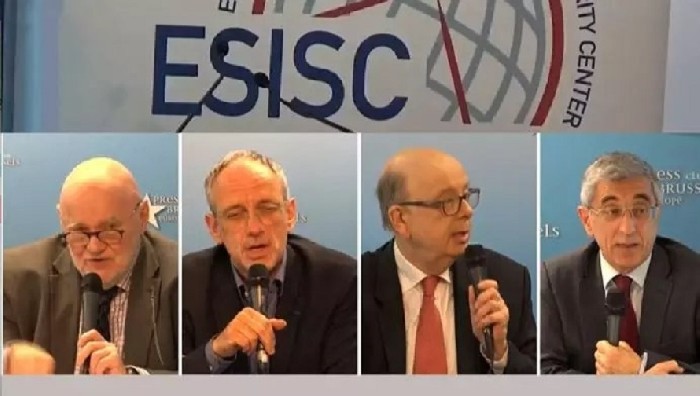
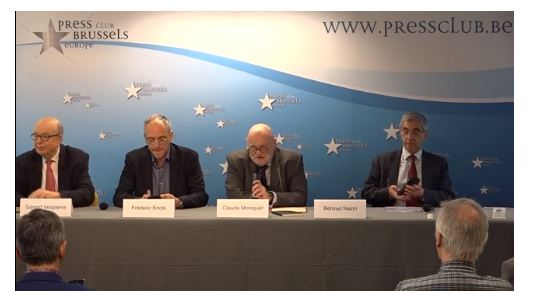
On Wednesday, April 26, 2023, a conference was held at the initiative of the European Strategic Intelligence and Security Center (ESISC) at the Press Club Brussels Europe.
The conference was entitled: “After Seven Months of Uprising, Is the Mullahs’ Regime Under Threat?”
It also addressed the following questions:
– Hostage diplomacy: What should Europe do?
– Why should the Islamic Revolutionary Guard Corps be placed on the European list of terrorist organizations?
The speakers at the conference were:
Frédéric Encel, Professor of International Relations and Political Science at PSB Paris School of Business and Associate Professor at Sciences Po Paris.
Gérard Vespierre, Associate Researcher at the Foundation for Middle East Studies (FEMO).
Behzad Naziri, member of the Foreign Affairs Committee of the National Council of Resistance of Iran (NCRI).
Claude Moniquet, former journalist and co-director of the European Strategic Intelligence and Security Center (ESISC).
Claude Moniquet: Let’s Try to Be Strong in the Face of an Iran That Seems Strong but Is, in Fact, Very Weak
Claude Moniquet, a former journalist and former field operative with the DGSE, worked on the Middle East and the Eastern Bloc. It is in these two capacities that he has followed the situation in Iran and what is known as the “Shiite Crescent”—Iraq, Syria, and Lebanon—for the past 40 years. He is the author of around twenty books. He is co-director of the European Strategic Intelligence and Security Center (ESISC).
Claude Moniquet spoke on April 26 at a conference at the Press Club Brussels, organized at the initiative of the ESISC, on the situation in Iran after several months of a crisis that is the most serious the regime has experienced since its establishment in 1979. Here is the transcript of his remarks.
I am going to talk to you today about two things: on the one hand, hostage diplomacy, and on the other, the issue of placing the Revolutionary Guards on the European list of terrorist organizations.
The Problem with the Iranian Economy Has Been Structural Since the Rise of Religious Rule
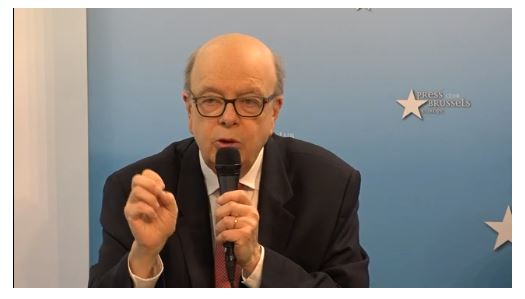
Gérard Vespierre is a geopolitical analyst, Associate Researcher at FEMO, the Foundation for Middle East Studies, and founder of the web media outlet Le Monde Décrypté. He spoke on April 26 at a conference at the Press Club Brussels, organized at the initiative of the European Strategic Intelligence and Security Center (ESISC), on the situation in Iran after several months of one of the most serious crises the regime has experienced since its establishment in 1979. Here is the transcript of his remarks:
I am going to draw on a few slides that have been specially prepared for you today. Together, we will try to go through the answers to these three questions. Is the very difficult situation of the Iranian economy exclusively linked to sanctions, or does it stem from other factors? Secondly, does the situation signal a social explosion? And thirdly, is the regime threatened at its foundations? Over the next fifteen minutes, we will try to examine together some answers to these three questions.
Maintaining Political and Diplomatic Pressure on the Odious Regime in Iran
Frédéric Encel is Professor of International Relations and Political Science at PSB Paris School of Business and Associate Professor at Sciences Po Paris. He spoke on April 26, 2023, at a conference organized at the initiative of the European Strategic Intelligence and Security Center (ESISC) at the Press Club Brussels Europe on the situation of the Iranian regime, seven months after the uprising. Frédéric Encel offered a perspective on the geopolitical dimension of the Iranian crisis. Here is a transcript of the main points of his remarks.
I think that objectively observing, studying, and analyzing realities is absolutely essential for a geopolitical analyst, of course, knowing two things.
First point: realities change. Ultra-realism, or the famous realpolitik, you know, the Prussian case that goes along with it, which seems very virile, is in reality a figment of the imagination, a bias that often blinds those who proclaim themselves ultra-realists, because realities change, and sometimes very quickly.
This Explosion of Iranian Society Is Not an Overnight Phenomenon
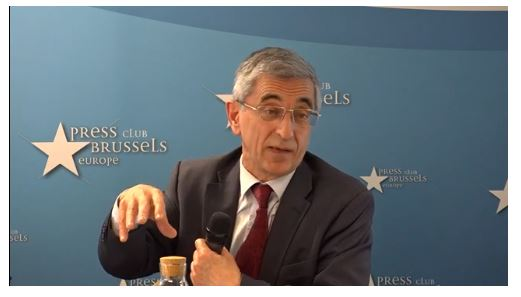
Behzad Naziri, a former journalist, is a member of the Foreign Affairs Committee of the National Council of Resistance of Iran (NCRI). He spoke on April 26, 2023, at a conference organized at the initiative of the European Strategic Intelligence and Security Center (ESISC) at the Press Club Brussels Europe. Drawing on his personal experience, he describes the trajectory of a regime that is in danger in the face of widespread opposition led by an organized resistance. He also denounces the harmful effects of a pseudo-opposition. He addresses the question posed by the conference: “After seven months of uprising, is the mullahs’ regime under threat?”
I am going to answer the question posed by this conference based on information from inside my country. Quite simply, the answer to the question—after seven months of uprising, is the mullahs’ regime under threat?—is yes, it is under threat. The threat is existential; that is to say, it is threatened with being overthrown by the Iranians. I am not the one answering this question; it is the Iranian street that is answering. The street says that this is the fateful year. There is a very well-known slogan that resonates strongly. You only have to look at some of the videos on social media. In Persian, it rhymes well: “Emsâl sâlé khouné, Seyed Ali sarnéguouné.” This means: “This is the year of blood; Seyed Ali will be overthrown.” Seyed Ali is the first and middle name of Khamenei, the regime’s Supreme Leader.