
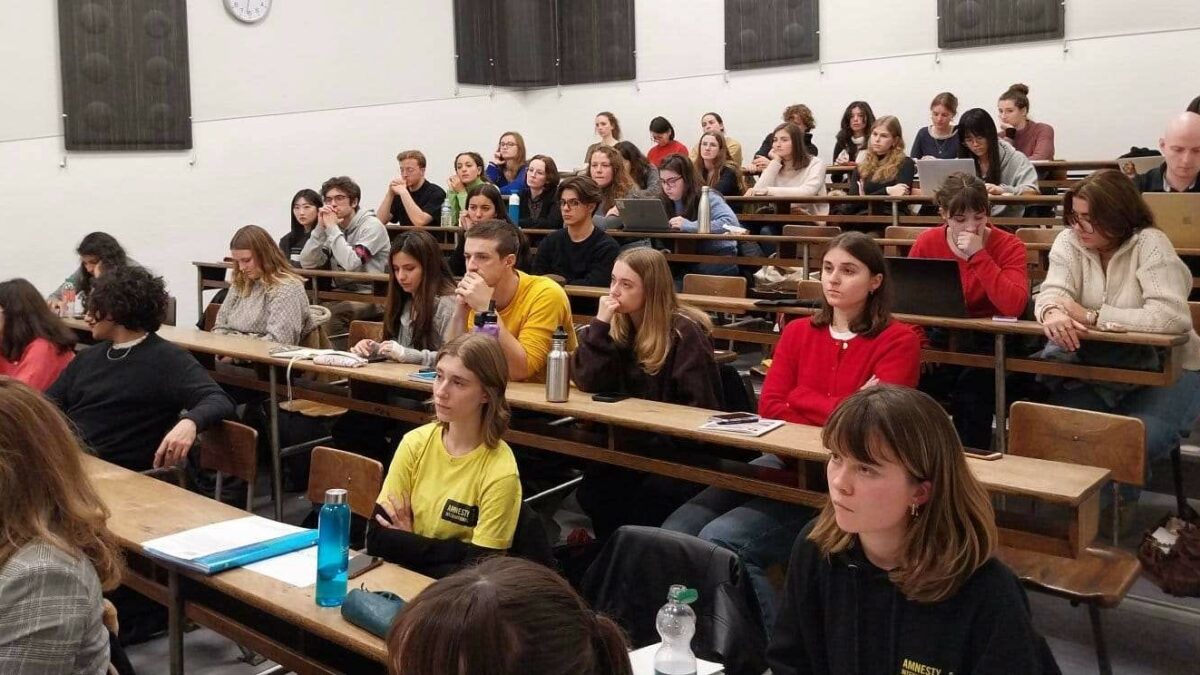
Conference at Sciences Po
On 13 November 2024, an exceptional conference was held at Sciences Po Paris on the theme of human rights, two years after the uprising that followed the death of young Jina Mahsa Amini in Iran. The meeting was organised by several student associations at Sciences Po: the Sciences Po Arab World Association, the Sciences Po Amnesty International Youth Group, and the Asia Society. Speakers from Amnesty International, the CSDHI (Committee in Support of Human Rights in Iran) and FEMO were invited to present the situation.
For nearly two hours, Jean-François Legaret (President of FEMO), Sara Nouri (lawyer and FEMO analyst), Fabrice Magnan de Bornier (Iran officer for Amnesty International) and Azadeh Alami (CSDHI) held the attention of a highly engaged and passionate student audience. The debate that followed the speakers’ presentations focused on the mechanisms of response to human rights violations in Iran, the challenges facing human rights activists, and the future stakes for Iranian society.
Jean-François Legaret
Jean-François Legaret gave an in-depth analysis of the situation in Iran, highlighting the regime’s repressive practices.
The repression of political prisoners — The President of FEMO explained that in Iran, every Tuesday, political prisoners in 24 prisons hold a hunger strike, now in its 41st consecutive week. He denounced recent death sentences, notably that of a young Iranian Kurdish opponent, Varisheh Moradi, those of three MEK activists in September, and of six other activists from the same movement more recently, for their role in the uprisings.
A regime in a state of panic — He stated that the regime’s greatest fear is not external attacks but a popular insurrection led by young Iranians, organised into resistance units across the country. These units, supported by the MEK, play a key role in organising the uprisings.
An escalation of executions — According to Mr Legaret, since the start of 2023, at least 700 protesters have been killed. He described these executions as a means for the regime to spread terror and deter any future rebellion.
A call for international solidarity — Mr Legaret urged the international community to document and disseminate these accounts in order to raise global awareness. Asked about the regime’s future, he replied: “This barbaric regime can only be overthrown by the Iranian people. Every voice and every act of solidarity counts in this fight for freedom.”
Amnesty International
Amnesty’s representative presented a report entitled “Don’t Let Them Kill Us,” documenting the systematic use of the death penalty in Iran. Fabrice Magnan de Bornier highlighted the crimes committed by the Iranian regime and the need to identify alleged perpetrators and, where sufficient evidence exists, issue international arrest warrants. He stressed the importance of pressuring the Iranian regime to end executions, notably by disseminating information and documenting human rights violations in Iran.
He underlined the particularly alarming situation regarding executions in Iran, which ranks second in the world after China in number of executions, with a rising rate since Raisi’s election in 2021. In 2023, the number of executions reached at least 853, a large proportion of which concerned offences that should not carry the death penalty under international law, such as acts related to freedom of expression or conscience. The execution of minors, including a 17-year-old boy in 2023, was also highlighted as a flagrant violation of international conventions.
Finally, the speaker criticised Iran’s judicial system, particularly the revolutionary courts, which lack independence and are controlled by the security services. Defendants there are deprived of their fundamental rights, such as the right to a fair trial and adequate defence, often under duress and torture.
The lawyer Sara Nouri
The lawyer explained that Iran is witnessing extrajudicial and unlawful executions, disproportionate and unnecessary use of force, arbitrary deprivation of liberty, torture and gender-based persecution. Women, children and members of ethnic and religious minorities are the main victims. “I want to emphasise that these acts form part of a widespread and systematic attack against the civilian population in Iran, targeting the women, girls, boys and men who demand freedom, equality and accountability,” she stated.
According to the expert, one particularly important point is the significant work of Professor Javaid Rehman on the massacre of the 1980s. Javaid Rehman, then UN Special Rapporteur on the situation of human rights in the Islamic Republic of Iran, extensively documented crimes such as the arbitrary and extrajudicial executions committed in 1988, which constitute crimes against humanity.
Azadeh Alami
A survivor of the repression, Azadeh shared her personal experience: her imprisonment alongside her mother as a child, followed by a clandestine escape from Iran after her mother’s miraculous release. She denounced the mass executions and stressed the importance of initiatives to raise awareness among European governments so they adopt a firmer stance against the Iranian regime. She drew particular attention to the case of an emblematic prisoner sentenced to 17 years in prison and currently held in solitary confinement, named Maryam Akbari Monfared.
Conclusion
This conference offered an essential space to discuss the tragic realities in Iran and to strengthen international mobilisation. The students present voiced their questions to the speakers and expressed their willingness to help raise public awareness.
Jean-François Legaret, in closing his remarks, recalled: “All dictatorships are mortal. The question is how long it will take before the Iranian people, with the help of the international community, overthrow this regime and proclaim democracy.”
The event was a powerful moment of reflection, solidarity and commitment to human rights.