
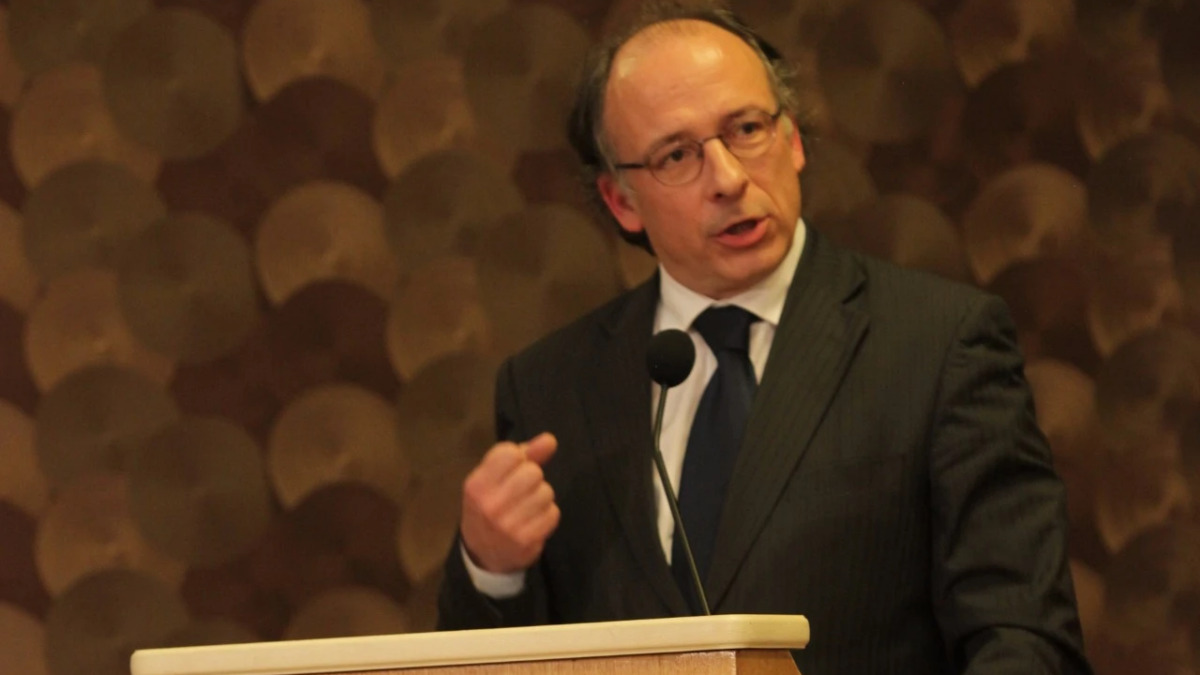
Transcript of Yves Thréard’s address at the FEMO conference at the Maison de la Chimie:
“Iran is a country I am fond of. When the revolution broke out in 1979, I had just returned from that country. This evening I have been asked to answer a vast question — if indeed it can be answered: what is the influence of the Iranian revolution, of this Iranian regime, on the spread of Islamism around the world?
I don’t know if you remember, but I have a very precise memory of 1979 — 35 years ago now — when Ayatollah Khomeini arrived in Tehran. I have an even more precise memory of the days before his arrival there, when he was staying in a town in the Yvelines called Neauphle-le-Château, where everyone went to visit him with such deference, and, I would say, such curiosity too. In 1979, nobody really knew what an imam was. We knew who the Shah of Iran was, and more or less knew that the Shah was not always gentle with his people — we had watched his imperial coronation on television. But Imam Khomeini received every courtesy — from the French authorities, for good reason, and he was visited and praised by Michel Foucault. But what I remember most is a visit by a neighbour of mine, Marguerite Duras, for a newspaper called Libération — Marguerite Duras conducted an interview with Imam Khomeini. Of course, at the time, we no doubt sinned through naivety, we were fairly ignorant, and we had no idea of this regime’s true intentions — intentions of liberation for a people, but intentions that turned out not to be ‘liberating’ for the Iranian people at all.
I heard the comparisons Bertrand Delais drew earlier with the Soviet regime — an easy comparison, but after all, Lenin was in Paris before making his revolution in Moscow, and Ayatollah Khomeini was in France before going to make his revolution in Iran, where he did not even need to fight, since the regime collapsed on its own… The Soviet communist regime lasted 70 years — how long, forgive the shorthand, will the Iranian regime last? That is the question everyone is asking today.
I would also like to say — because I did some research and went back to look at what Ayatollah Khomeini had said and declared upon coming to power in 1979 — that he indeed had the ambition to seize power in his own country, perhaps through rhetoric, claiming to liberate it, but he also had an expansionist ambition toward the entire world — not only the Arab or Muslim world, but the whole world — because this was, of course, the revenge he sought against the West, against the Great and Little Satans. I found declarations about this triumphant Islam that would defend the Quran against the infidels of the West. And there are also statements from certain Western leaders: an Israeli, Moshe Dayan, said precisely when Ayatollah Khomeini arrived in Tehran: ‘It’s an earthquake — see you soon!’ Moshe Dayan, who in fact died two years after Khomeini’s arrival in Tehran, seemed to be saying — and this reading holds up in hindsight — ‘see you soon,’ but forever! And when war broke out between Iran and Iraq — with Iraq starting that war, incidentally — Mitterrand uttered this line: if we do not support Iraq, the wind of the Islamic revolution will reach the Atlantic Ocean. This shows that, at the time, everyone was aware the danger was real, and that this expansionist danger, carried in Ayatollah Khomeini’s diatribes — very sober in tone but very heavy in substance — represented a danger to the world. Hence the danger to the West, but also to part of the Arab world, which is also why Saddam Hussein went to war against Iran.
Now, of course, you might say: how can we talk about the spread of Islamism while forgetting certain things? First, that Iranians are Persian, whereas the vast majority of the Muslim world is Arab — hence a duality, a rivalry. Second, that on one side you have Shias, a minority, and on the other, Sunnis, who form a large majority of the Muslim world. Yet, looked at closely, this opposition is ultimately quite relative on a fundamental level. It is probably very strong politically, but much more relative fundamentally, because the differences are essentially less doctrinal than dynastic.
On that basis, if we distinguish between populations and regimes, we can say that the embodiment of an Islamic regime that Tehran represented at the time exerted a strong influence on Arab populations neighbouring Iran — because they saw in it, perhaps, a reflection of what they themselves wanted, in opposition to the autocratic regimes governing them, regimes under which they often found themselves oppressed. That, of course, applies to Sunni countries, but also to countries with Shia majorities — Iraq being precisely such a case, where the majority of the population is Shia. And then there is Lebanon, with Hezbollah, which found in Iran a reason to fight and make itself heard that it could not otherwise have had. This shows that the regime, once installed in Tehran, harboured expansionist ambitions and also intended to serve as a force of resistance, asserting itself against a Saudi Arabia it considered far too subservient to the American ‘Great Satan.’
This expansionism has had terrorist and military expressions — no need to elaborate on Hezbollah, in Lebanon and beyond — since the idea, for Iran, was to strike out in self-defence against its own domestic opponents, and the Iranian resistance movement paid dearly for this. It also meant protecting itself by striking against Western forces, notably the United States and France. We remember the 1983 Beirut bombings. And I even noted — I was quite astonished by the sheer number of attacks in Paris in 1985 and 1986, likely carried out by Hezbollah: between February 1985 and September 1986, there were ten attacks in Paris almost certainly committed by Hezbollah, with Fouad Ali Saleh not far off.
I also wanted to discuss these demonstrations, this stoking of the Muslim community to ‘whip up’ its Islamic sympathies. Iran made extensive use of this on two occasions of global scale, which allowed it to keep alive a flame very useful for sustaining its regime, as an example of political Islam — because that is what must be understood here. First, the Salman Rushdie Satanic Verses affair in 1989. In France, almost no one had read The Satanic Verses; in Algeria, almost no one had read The Satanic Verses; in the United States, almost no one had read The Satanic Verses — with all due respect to Salman Rushdie! So who whipped up this hysteria around the book? The Iranian regime, obviously. A second example, much closer to us, came in 2006 — remember the Danish cartoons affair, later picked up in France. These were instances of manipulation that were not local in origin. I looked into how this chain of events unfolded, and this hysteria originates precisely in Tehran — which is invariably the first to exploit such episodes.
The main point — one we keep hearing repeated today — is that political Islam has failed: it failed in Egypt, it failed in Tunisia… But if you think about it carefully, political Islam still exists — in Iran. So its work is not finished, and neither is Iran’s. Through the instrumentalisation of the nuclear weapon, and through other economic files, Iran has not finished exerting a very powerful influence, transcending Sunni-Shia and Persian-Arab divisions, across the world. That is what is genuinely interesting when analysing this regime — the first regime in contemporary history to be an Islamist regime, and one that today proudly claims that identity. Of course, you might mention Saudi Arabia… but that regime did not come to power through revolution. And that is what is worth noting today, in contrast to the West.”
11 February 2014