
By the Editorial Team
On 5 October 2026, a closed-door conference entitled “Beyond Engagement and War: Towards a New Strategy Towards Iran” was held in Brussels at the initiative of the Charles Michel Office and the Middle East Studies Forum (FEMO). It brought together former heads of state and government, policymakers, ambassadors, diplomats, researchers and experts.
Chaired by Charles Michel, President Emeritus of the European Council, and Jean-François Legaret, President of FEMO, the roundtable examined more than four decades of international policy towards Iran, characterised by an alternation between two main approaches: diplomatic engagement with the regime in power and, more recently, confrontation, particularly through the use of external military pressure. According to the participants, neither of these strategies has provided a lasting response to the main challenges posed by Iran, whether in terms of human rights violations, its regional interventions, its support for armed groups or its nuclear ambitions.
Against a backdrop of growing domestic dissent, persistent political divisions and increasing public aspirations for democratic change, the question of what strategy to adopt towards Iran remains central. Regional tensions and security concerns relating to the Strait of Hormuz further reinforce the need to rethink traditional approaches. The discussions therefore focused on possible alternatives beyond the choice between diplomatic engagement and military confrontation.
This high-level roundtable provided an opportunity to assess the limitations of the strategies pursued to date and to examine new policy options. The discussions also emphasised the promotion of democratic change, respect for human rights, the fight against impunity and regional stability. Participants were able to compare their analyses and engage in open exchanges on the prospects for a new international approach towards Iran.
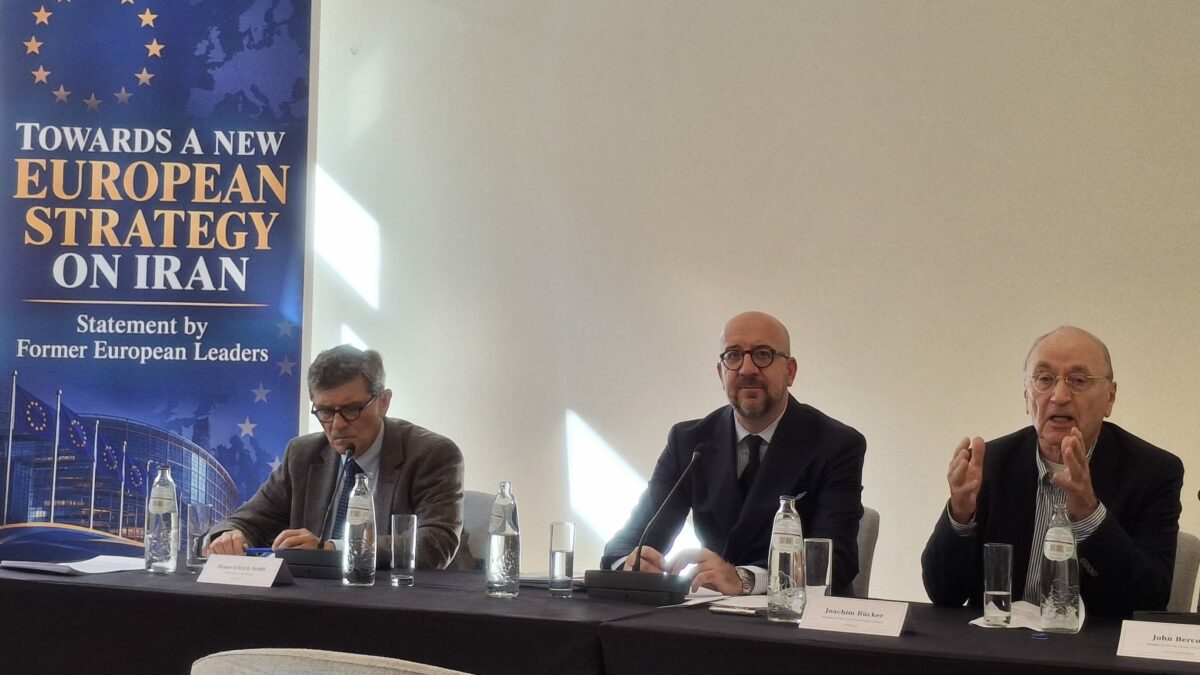
On the sidelines of the roundtable, a press conference was held in the presence of Charles Michel, Hans-Ulrich Seidt, Joachim Rücker and John Bercow. It provided an opportunity to issue a solemn call by former European leaders for a change in strategy towards Iran.
Former President of the European Council Charles Michel called on Europe to reconsider its approach towards Iran and move beyond diplomatic strategies which, according to the signatories of a joint appeal, have failed to deliver lasting results.
Through this appeal, several European figures, including former Belgian Prime Ministers Guy Verhofstadt and Yves Leterme, as well as Jean-Pierre Raffarin and Paolo Gentiloni, are urging current European leaders to consider new options in dealing with the Iranian regime. In particular, they stress the need to place the aspirations of the Iranian people and their right to freely determine their own future at the heart of any prospect for democratic change.
Charles Michel argued that the approaches pursued so far had failed to produce the expected results. He also criticised the military strikes carried out by the United States and Israel in Iran, describing them as contrary to international law and considering that they would neither improve the situation of the Iranian people nor strengthen regional stability. He called on European governments to demonstrate political courage and move beyond the status quo.
John Bercow, former Speaker of the British House of Commons; Joachim Rücker, former President of the United Nations Human Rights Council; and Hans-Ulrich Seidt, former German ambassador to Afghanistan, also echoed this call for a change in approach.
Speaking on this occasion to The Brussels Times, Farzin Hashemi, a member of the Foreign Affairs Committee of the National Council of Resistance of Iran (NCRI), advocated a third path, distinct both from cooperation with the regime in power and from foreign military intervention. According to him, change must be driven by the Iranian people and by the resistance within the country. He also outlined the NCRI’s programme, which provides for the organisation of elections within six months of the regime’s overthrow, as well as the transfer of power to elected representatives.
This appeal launched in Brussels thus highlights the need to undertake an in-depth reassessment of European policy towards Iran, draw lessons from the limitations of previous diplomatic and military approaches, and place the aspirations of the Iranian people at the centre of any prospect for a democratic transition.
Read the article in The Brussels Times
‘We have collectively failed’: Charles Michel leads European call for new strategy on Iran
Tuesday, 6 October 2026
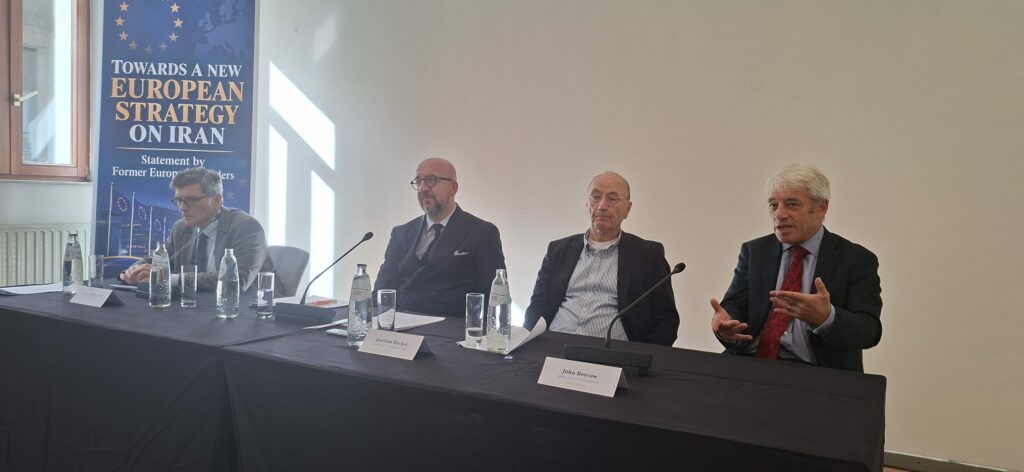
From left to right: Hans-Ulrich Seidt, Charles Michel, Joachim Rucker, John Bercow. Credit: The Brussels Times
Belgium’s former Prime Minister Charles Michel is spearheading a Europe-wide campaign to persuade governments to ditch political and diplomatic engagement with the Iranian regime – and is urging US President Trump to end his illegal military attacks on the country.
Here is the text of the appeal issued by former European leaders calling for a change in strategy towards Iran:
Towards a New European Strategy on Iran
The European Council,
1. Recognises that the situation in Iran has profound consequences not only for the Iranian people, who have endured decades of repression and systematic violations of their fundamental rights, but also for regional and international peace and security through the regime’s support for terrorism, including against Ukraine, regional destabilisation, and religious extremism abroad.
2. Notes that decades of repeated concessions, through diplomatic engagement, have failed to bring about a fundamental change in the regime’s behaviour, while military confrontation has likewise failed to provide a sustainable solution to the Iranian crisis. The European Union should therefore consider new strategic options rather than repeat approaches that have failed to deliver lasting results.
3. Calls for a new European approach to Iran, placing the Iranian people at the heart of the strategy, recognising them as the principal agents of democratic change and supporting their ability to shape their country’s political future through democratic means.
4. Underlines that such an approach should put international law, human rights, accountability, and the fight against impunity at the centre of European policy towards Iran.
5. Invites the High Representative and the European External Action Service, in consultation with Member States, to develop and present new strategic options for the European Union’s policy towards Iran, based on these principles and taking into account Europe’s security interests, values, and long-term strategic objectives, with a view to supporting the emergence of a democratic, non-nuclear Republic of Iran, at peace with its neighbours and committed to regional stability.
6. Considers that developing such a strategy is an expression of European strategic sovereignty: the capacity of the European Union to define its policy towards Iran on the basis of its own interests, values, security priorities, and principles, while acting in accordance with international law.
Here is the complete list of signatories to the appeal:
Charles Michel — Ancien Premier ministre de Belgique ; Ancien président du Conseil européen
Paolo Gentiloni — ancien Premier ministre italien
Jean-Pierre Raffarin — ancien Premier ministre français
Geir H. Haarde — Ancien Premier ministre d’Islande
Guy Verhofstadt — Ancien Premier ministre de Belgique
Enda Kenny — Ancien Premier ministre d’Irlande
Yves Leterme — Ancien Premier ministre de Belgique
Lamberto Zannier — Ancien secrétaire général de l’OSCE
Eamon Gilmore — Ancien représentant spécial de l’UE pour les droits de l’homme ; ancien ministre des Affaires étrangères d’Irlande
Georgi Bliznashki — Ancien Premier ministre de Bulgarie
Borut Pahor — Ancien président de la Slovénie
Lawrence Gonzi — Ancien Premier ministre de Malte
Carlo Cottarelli — Ancien Premier ministre désigné d’Italie
Petre Roman — Ancien Premier ministre de Roumanie
Avdullah Hoti — Ancien Premier ministre du Kosovo
John Bercow — Ancien président de la Chambre des communes britannique
Jeppe Kofod — Ancien ministre des Affaires étrangères du Danemark
Joachim Rücker — Ancien président du Conseil des droits de l’homme des Nations Unies
Peter Altmaier — Ancien ministre fédéral de l’Économie et de l’Énergie d’Allemagne
Dick Spring — Ancien ministre des Affaires étrangères d’Irlande
Hans-Ulrich Seidt — Ancien ambassadeur d’Allemagne en Afghanistan
Alexandru Athanasiu — Ancien Premier ministre de Roumanie
Joseph Muscat — Ancien Premier ministre de Malte
Erkki Tuomioja — Ancien ministre finlandais des Affaires étrangères