
By Franck Radjai and Maceo Ouitona
For decades, the Strait of Hormuz has stood as one of the major vulnerabilities of the global economy. The war launched against Iran in February 2026 and the subsequent disruptions served as a brutal reminder of this dependency. Yet, they have also accelerated an opposite movement: Saudi Arabia, the United Arab Emirates, and Iraq are now seeking to develop routes enabling them to export their hydrocarbons without passing through the Strait. Ultimately, Hormuz could thus lose part of its strategic weight. Making it obsolete, however, is quite another matter. The capacities of alternative infrastructures remain insufficient, certain Gulf producers have practically no fallback solutions, and bypass routes create their own vulnerabilities.
For nearly six months, the near-paralysis of the Strait of Hormuz provided Gulf countries with a full-scale demonstration of the risk they had known for a long time.
Before the war, nearly 20 million barrels of oil and petroleum products per day transited this passage located between Iran and Oman. This represented roughly a quarter of global seaborne oil trade. Nearly 80% of these volumes were destined for Asia. Added to this oil dependence was that of liquefied natural gas: more than 110 billion cubic meters of LNG had transited through Hormuz in 2025.
Since the beginning of the war in late February 2026, this model has been profoundly shaken. In March, the International Energy Agency (IEA) estimated that oil flows through the Strait had dropped from about 20 million barrels per day before the conflict to a residual quantity. This disruption triggered massive production cuts in the Gulf due to the inability to export produced hydrocarbons normally. The IEA described the situation as the largest supply disruption ever recorded on the global oil market.
The strategic lesson is hard to ignore: for several Persian Gulf states, depending almost exclusively on Hormuz amounts to leaving an essential part of their economy exposed to a single military crisis.
Hence a now central question: is the tension in the Persian Gulf bringing about what several decades of friction with Iran had not truly accomplished—namely, the gradual construction of an alternative to the Strait of Hormuz?
Hormuz: A Long-Recognized Vulnerability
Geography accounts for a large part of the problem.
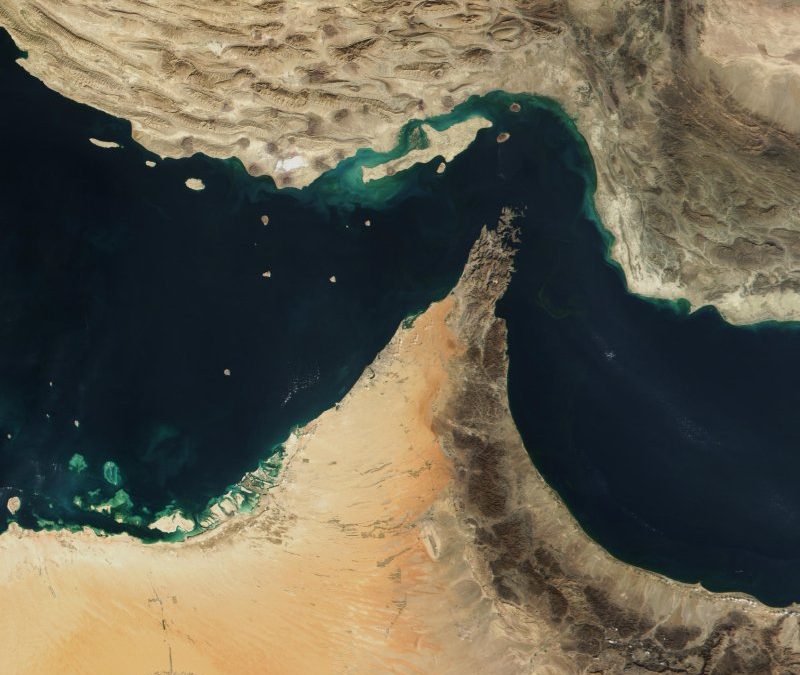
The Strait of Hormuz connects the Persian Gulf to the Gulf of Oman and subsequently to the Indian Ocean. At its narrowest point, it measures about 39 kilometers. Ships use two navigable lanes of approximately 3.7 kilometers each, separated by a buffer zone of comparable width. This configuration allows the passage of Very Large Crude Carriers (VLCCs), but concentrates a considerable share of global energy trade within an extremely confined space.
The importance of the Strait stems primarily from the location of the main oil fields and terminals. Saudi Arabia, the United Arab Emirates, Iraq, Kuwait, Qatar, Bahrain, and Iran all possess facilities facing the waters of the Persian Gulf.
This dependence is not, however, uniform.
Saudi Arabia and the UAE have long invested in infrastructure enabling them to partially bypass the Strait. Conversely, Iraq, Kuwait, Qatar, Bahrain, and Iran remain much more dependent on this maritime route for their exports.
The 2026 war transformed this disparity into a major strategic advantage.
Saudi Arabia Had Already Begun Preparing for the Post-Hormuz Era
Probably the most important infrastructure is the Saudi East-West pipeline, often called Petroline.
It connects the oil facilities in the east of the kingdom to the port of Yanbu on the Red Sea. Its principle is simple: a barrel produced near the Persian Gulf can cross the Arabian peninsula by pipeline and then be loaded onto a tanker without ever crossing Hormuz.
The nominal capacity of the system is traditionally estimated at around 5 million barrels per day. Saudi Aramco indicated that it had raised this capacity to about 7 million barrels per day, even though the IEA stresses that the ability to sustainably maintain such a flow has not yet been fully demonstrated. Before the war, about 2 million barrels per day were already taking this route.
When traffic through Hormuz collapsed, Riyadh therefore had a solution that several of its neighbors lacked.
The war reinforced the appeal of this infrastructure and pushed Saudi Arabia to develop the logistical capacities of its western facade. More broadly, Gulf states have accelerated their investments since the beginning of the conflict in pipelines, terminals, ports, and infrastructure designed to reduce their dependence on Hormuz.
This movement goes beyond a simple response to a temporary crisis. For the region’s producers, the goal is now to transform the redundancy of export routes into a permanent element of their national security.
The UAE Already Possesses a Geographic Advantage
The United Arab Emirates adopted a similar strategy.
The Abu Dhabi Crude Oil Pipeline connects the facilities of Habshan to the port of Fujairah, located on the Gulf of Oman and thus outside the Strait. Its current capacity is estimated at around 1.8 million barrels per day. Even before the war, about 1.1 million daily barrels used this infrastructure. The IEA estimated in early 2026 that roughly 700,000 additional barrels could still be transferred through it in the event of a closure of Hormuz.
This infrastructure gives the UAE an advantage that the war made particularly visible.
Fujairah can serve simultaneously as an oil terminal, a storage hub, and a logistical platform opening directly onto the Indian Ocean. Emirati authorities are now seeking to reinforce this function, while port investments and additional pipeline projects are multiplying.
The energy geography of the Persian Gulf is thus beginning to evolve: what was once a precautionary infrastructure is gradually becoming a central element of export strategy.
For Iraq, the War Turned Diversification Into an Urgency
The contrast is particularly striking with Iraq.
Before the conflict, the bulk of its exports originated from the large southern fields and left the country from terminals located in the Gulf. Baghdad therefore depended very heavily on Hormuz despite the historical existence of export routes running north.
The war made this vulnerability impossible to ignore.
Iraq is now working on building a network to route more crude toward Turkey, Syria, and potentially Jordan. A project connecting the south of the country to the Syrian coast could eventually have an initial capacity close to 2 million barrels per day, but its construction would require several years and investments estimated at least at $15 billion.
Simultaneously, Baghdad is seeking to strengthen its export capacities toward the Turkish port of Ceyhan and resumed limited land-based exports to Syria in September.
The strategic objective appears clear: a country whose public finances depend massively on oil no longer wants to be placed in a situation where a crisis at Hormuz can brutally reduce its capacity to commercialize its primary resource.
Yet the Iraqi case also reveals the primary limit of the current movement: building an alternative on a map does not mean immediately having an operational alternative.
The major oil fields are located in the south, north-south infrastructure remains insufficient, and projects toward Syria require several years. Even if the announced pipelines are completed, a large share of Iraqi oil customers are in Asia. Yet for these buyers, loading crude directly in the Persian Gulf and then crossing Hormuz remains logistically simpler than routing it all the way across Iraq before loading it in the Mediterranean.
The War Is Thus Reducing the Value of the Iranian “Chokepoint”
This diversification could progressively alter the balance of power surrounding the Strait.
For decades, Iran’s geographic position has provided it with a powerful potential means of pressure: any serious threat to navigation in Hormuz immediately sparks fears of a major disruption to global energy supplies.
Yet this strategic weapon contains its own paradox.
The more it is used, the more it encourages other states to invest in reducing its effectiveness.
The billions devoted to new pipelines, the ports of Fujairah and Yanbu, Iraqi connections to the Mediterranean, or storage infrastructure probably would not have had the same urgency without the disruptions of 2026.
The war therefore acts as an accelerator. It transforms the diversification of energy routes—once conceived essentially as an insurance policy—into a structural policy.
Ultimately, a larger share of Gulf oil could leave the region without crossing Hormuz. This would mechanically reduce the capacity of a disruption in the Strait to simultaneously interrupt the majority of regional exports.
That being said, speaking of the upcoming disappearance of Hormuz’s strategic importance would be misleading.
The Figures Show Just How Difficult Hormuz Remains to Replace
The first limit is quantitative.
In 2025, nearly 20 million barrels of oil and petroleum products per day transited through the Strait. According to IEA estimates, the Saudi and Emirati pipelines together possessed only 3.5 to 5.5 million barrels per day of available capacity capable of being used to bypass Hormuz.
Even by operating these infrastructures much more intensively, the gap remains considerable.
The U.S. Energy Information Administration reached the same conclusion: existing alternative routes can absorb only a fraction of the volumes normally shipped through the Strait.
The closure of Hormuz does not merely provoke a change of itinerary comparable to the diversion of a ship around a dangerous zone. It can force producers to cut production because they simply lack sufficient capacity to transport their hydrocarbons to other ports.
This is precisely what happened at the beginning of the war.
Qatar Illustrates the Most Obvious Limits of Bypassing
Oil is, moreover, only part of the problem.
Qatar is one of the world’s leading exporters of liquefied natural gas, but its gigantic Ras Laffan complex is located inside the Persian Gulf. According to the IEA, about 93% of Qatari LNG exports transited through Hormuz before the conflict. Combined with Emirati exports, LNG volumes moving through the Strait accounted for roughly 19% of global LNG trade.
Yet transporting natural gas via another route is markedly more complex than diverting a share of oil to an existing pipeline.
The consequence proved spectacular. QatarEnergy had to purchase dozens of cargoes of American LNG to supply certain of its Asian clients when its own exports were disrupted.
In late September, the company had further extended force majeure declarations concerning several clients, while Reuters estimated that Qatari LNG exports had dropped dramatically since April.
For Doha, therefore, no true physical substitute for Hormuz exists today.
Building a massive overland gas network crossing multiple states would be a politically, financially, and technically much more complex project than a national oil pipeline.
Bypassing a Chokepoint Can Simply Relocate the Risk
Above all, there is a second paradox. An alternative route is not necessarily a safe route.
Saudi Arabia experienced this in September. Its East-West pipeline—precisely designed to enable the kingdom to bypass Hormuz and export from Yanbu—was disrupted following drone attacks attributed by Riyadh to Iraqi-linked armed groups. Loadings at Yanbu resumed only several weeks later.
During this interruption, a much larger share of Saudi oil had to return toward… Hormuz.
Reuters estimated that Saudi exports passing through the Strait could reach about 3.6 million barrels per day in September, compared to only 900,000 in August. The increase in oil transfers off the coast of Oman even contributed to saturating ship-to-ship transfer capacities in the area.
This episode alone summarizes the limits of the notion of a “post-Hormuz” era.
A pipeline crossing the Arabian peninsula can avoid the Strait, but it becomes a strategic infrastructure susceptible to being struck. A terminal on the Red Sea allows escape from Hormuz, but the tankers utilizing it can subsequently be exposed to tensions around Bab el-Mandeb. A route to the Mediterranean across Iraq and Syria bypasses the Persian Gulf, but it traverses territories that themselves present security risks.
The problem is therefore not merely exiting Hormuz. It consists of building an entire supply chain sufficiently secure to replace the one that already exists.
And Tankers Continue to Return to the Strait
The movements observed in late September provide another important indication.
Despite seven months of conflict, several LNG carriers linked to QatarEnergy began visibly crossing Hormuz again. Maritime tracking data analyzed by Reuters show a partial recovery in the movements of vessels loaded with or heading toward Qatari terminals.
This return is not proof of a return to normal. It nevertheless demonstrates something essential: when the risk level becomes sufficiently acceptable, economic actors reuse the Strait.
They do so because Hormuz owes its importance not only to the absence of political alternatives. It also owes it to the economic and geographic efficiency of the route.
For hydrocarbons produced on the shores of the Gulf and destined primarily for China, India, Japan, or South Korea, exiting directly through Hormuz and then reaching the Indian Ocean often remains the shortest and most logical itinerary.
Transporting the same oil over hundreds or thousands of kilometers by pipeline to the Red Sea or the Mediterranean before reloading it onto a vessel may offer additional strategic security, but it also entails new infrastructure, costs, port capacities, and sometimes longer maritime journeys.
Geography does not disappear simply because a state decides to diversify its trade routes.
Toward a Less Unavoidable, Rather Than Obsolete, Hormuz
The 2026 war could thus profoundly alter the role of the Strait without making it disappear from the strategic equation.
Over the medium and long term, Saudi Arabia and the UAE should be able to route a larger proportion of their oil through terminals located outside the Persian Gulf. Iraq is attempting to rebuild outlets toward Turkey and the Mediterranean. Other projects could emerge as the region’s governments factor geopolitical risk into their investment decisions.
This evolution could progressively reduce the global impact of a Strait disruption and thus diminish the value of the threat posed by its closure.
Yet reducing a dependence is not eliminating it.
Hormuz retains three advantages that no current project can entirely replicate: considerable capacities, direct access to the main oil and gas complexes of the Gulf, and a natural orientation toward the Asian markets that absorb the bulk of regional exports.
Above all, certain states currently have no credible large-scale alternative. Qatar remains imprisoned by the geography of its gas industry. Kuwait and Bahrain remain heavily dependent on the passage. Iraq will need several years before potentially possessing infrastructure capable of transporting a large share of the crude produced in the south.
The war could thus produce a more subtle outcome than the obsolescence of the Strait.
It is transforming Hormuz from an almost unavoidable passage into a vulnerability that the Gulf states now want to actively dilute.
That is already a major strategic evolution.
Yet the events of September also reveal its limits: when the Saudi pipeline to the Red Sea was interrupted, oil returned to Hormuz; when navigation conditions improved slightly, Qatari LNG carriers began crossing the Strait again.
This back-and-forth movement recalls a reality that maps of new pipelines can easily mask. Alternative routes can reinforce the resilience of the Persian Gulf. They can diminish the capacity of a single crisis to paralyze the entire region. They can even, over time, reduce the strategic power that Iran derives from its proximity to the Strait.
But they cannot easily replicate the efficiency of a maritime passage located precisely at the exit of one of the greatest concentrations of hydrocarbons on the planet.
The war against Iran could thus mark the beginning of a relative downgrading of Hormuz. It does not spell its strategic demise.
Paradoxically, by pushing the Gulf states to seek ways to free themselves from it, the 2026 crisis will have above all demonstrated just how difficult it remains, even today, to do without it.
Franck Radjai is an analyst at FEMO and a research director at CNRS.
Maceo Ouitona is a journalist and consultant.